If diamonds are a girl’s best friend, says Lee Wild in Investors Chronicle, then the firms that mine them must surely be an investor’s best friend. Thanks to De Beers’ marketing campaign, diamond retail sales in China alone “are expected to grow at up to 20% a year”. Coupled with similarly burgeoning demand from India, that should sustain worldwide demand growth of “around 5% a year for the next decade”.
Simultaneously, production at some of the world’s biggest mines is beginning to tail off; in-ground resources have declined from 85 years worth of production in the mid-1980s to around 20 years worth today; and De Beers’ fabled $5bn stockpile “has been sold off”. Indeed, the diamond-mining industry is in “the most positive situation” it’s seen for the last 30 years.
London’s Aim market is currently host to 20 diamond exploration firms. One favoured by broker Collins Stewart is Petra Diamonds (Aim:PDL, 93p), which has exposure to three South African mines through its merger with Crown Resources a year ago and to Botswana through its acquisition of Kalahari Diamonds in September. The broker has a short-term price target of 121p per share on the company (32% above current levels), while Hargreave Hale has one of 135p (47% above).
Apart from the majors, other diamond firms to look at include Dwyka Diamonds (Aim:DWY, 34p); Gravity Diamonds (Aim:GRN, 14.5p); BDI Mining (Aim: BDI, 27p); Firestone Diamonds (Aim:FDI, 136p); African Diamonds (Aim:AFD, 165p); The Sierra Leone Diamond Company (Aim:SLD, 105p); SouthernEra Diamonds (Aim:SRE, 26.5p); Karelian (Aim:KDR, 5.75p) and European Diamonds (Aim: EPD, 24.75p).
By Author Charlie Gibson May 25, 2006
Jan 24, 2009

Jan 17, 2009
Large Diamonds
diamond, diamonds, buy diamond, buy diamond online,purchase diamond, diamond earring, diamond necklace, diamond ring, diamond bracelet, diamond pendant, wedding ring, engagement ring, diamond jewelry for woman, shop diamond, shop diamond online,fine diamond jewelry,engagement and wedding rings,diamond white gold rings,promise rings,customized jewelry


Large Diamonds
Rare colored diamonds over 5 carats in a variety of colors.
Yellow Diamonds
Yellow diamonds provide a subtle, dramatic aura in tones ranging from intense yellow hue to rich, softer light tones.
Pink Diamonds
The most popular diamond amongst connoisseurs, a pink diamond is the ultimate symbol of feminity, love and grace.
Blue Diamonds
Considered extremely rare, the shades of blue diamonds share the powerful blue of the sea, the sky or a pale winter day.
Red Diamonds
Rarest of the fancy color diamonds, red color diamonds are not often seen by most diamond collectors or jewelers.
Green Diamonds
Very rare indeed, few new natural green diamonds make it to market each year, taking eons for the natural green to color to develop.
Orange Diamonds
Though one of the most sought after colors by experienced collectors, many have not even seen a diamond with a pure orange grading.
Purple Diamonds
The cut of a true purple color diamond is important to release the the natural hue of the purple color.
Bracelets

Bracelets
Our over the top Colored Diamond Bracelets are not only beautiful, they can be matched with our stunning rings, earrings and necklaces.
view bracelets
Diamond Jewelry - Rings
 Rings
RingsOur over the top rings are really over the top. Fancy intense diamond rings,ranging from soft light tones, to intense yellow hues. Most of our rings are rare, one of a kind colored diamonds.
Jewelry-related links
Here are some Jewelry-related links found on the web today:
First up, Damien Hirst skull is sold for $100 million, NOT to Graff.
Hamptons.com discusses the history of diamonds.
Fashionista on Van Cleef’s runway stint with Elite Modeling agency.
Mining MX muses over the brand new landscape of mining, the diamond industry and De Beers.
Forbes reports that profits @ Zales are up in Q4.
Remember that 7000 carat diamond from a couple of days ago, with only a far away picture as proof? They won’t “test” it until next week, or earliest over the weekend. If they send me a CLOSE UP picture, I’ll confirm for them that it’s not diamond right away. In fact, I’ll confirm it without looking at a picture. If that turns out to be a diamond, then I’m a monkey’s uncle. By the way, it seems that the spokesperson for this group was involved in a timeshare scheme. Some people were even saying the discovery of this diamond was prophesied. Mkay..
I was just telling you the origin of the term Tennis Bracelet. Chris Evert lost her bracelet during a tournament and this created the name. Well something similar just happened to a runner with a $20,000 Broach. Jogger Broaches anyone?
Collector’s Universe GCAL division to Grade for Christies.
Celine Dion and Yang Lang to market engagement rings to Chinese market with HV Love.
Hotel Housekeeping ruined Bride’s wedding with major jewelry theft. Some of the items were recovered.
There’s an Indian Diamond Flick coming out.
De Beers to open store in famous GUM department store in Russia.
Herald Tribune: Demand for diamonds growing in India & China.
Moissanite market growing too.
Gemesis doubling operation.
Spot Runner cuts deal with Stuller.Summer sparkles @ Newsweek.
Ivana and Ivanka already expanded into Jewelry, now The Donald joins the fray in partnership with Fabrikant.
First up, Damien Hirst skull is sold for $100 million, NOT to Graff.
Hamptons.com discusses the history of diamonds.
Fashionista on Van Cleef’s runway stint with Elite Modeling agency.
Mining MX muses over the brand new landscape of mining, the diamond industry and De Beers.
Forbes reports that profits @ Zales are up in Q4.
Remember that 7000 carat diamond from a couple of days ago, with only a far away picture as proof? They won’t “test” it until next week, or earliest over the weekend. If they send me a CLOSE UP picture, I’ll confirm for them that it’s not diamond right away. In fact, I’ll confirm it without looking at a picture. If that turns out to be a diamond, then I’m a monkey’s uncle. By the way, it seems that the spokesperson for this group was involved in a timeshare scheme. Some people were even saying the discovery of this diamond was prophesied. Mkay..
I was just telling you the origin of the term Tennis Bracelet. Chris Evert lost her bracelet during a tournament and this created the name. Well something similar just happened to a runner with a $20,000 Broach. Jogger Broaches anyone?
Collector’s Universe GCAL division to Grade for Christies.
Celine Dion and Yang Lang to market engagement rings to Chinese market with HV Love.
Hotel Housekeeping ruined Bride’s wedding with major jewelry theft. Some of the items were recovered.
There’s an Indian Diamond Flick coming out.
De Beers to open store in famous GUM department store in Russia.
Herald Tribune: Demand for diamonds growing in India & China.
Moissanite market growing too.
Gemesis doubling operation.
Spot Runner cuts deal with Stuller.Summer sparkles @ Newsweek.
Ivana and Ivanka already expanded into Jewelry, now The Donald joins the fray in partnership with Fabrikant.


Visit Collection
The Aurora Pyramid of Hope is on exhibit at The Natural History Museum in London.Opening of new gallery November 28, 2007.Click here to visit.Webnhm.ac.ukSwitchboard+44 (0)20 7942 5000(9:00am-5:30pm Mon-Fri)Life Galleries information desk+44 (0)20 7942 5011(10:00am-5:30pm Mon-Sun; 11:00am-5:30pm Sun)Customer services+44 (0)20 7942 5511(10:00am-6:00pm Mon-Fri)LocationThe London Natural History Museum is located at Cromwell Road, London SW7 5BD, UKHours of OperationMon-Sun; 10:00am - 5:50pmThe Museum is open every day except 24-26 December. Last admission is at 5:30pm.
© 2008 Aurora Gems Inc. Site by Transition Networks.
© 2008 Aurora Gems Inc. Site by Transition Networks.
History of Colored Diamonds

The mystique of diamonds has fascinated mankind since these precious stones were first discovered, probably as early as 3000 B.C.Collected, treasured, and sought-after even to the point of malice, they became symbols of power and wealth. Their beauty and glamour is desired more than any other gemstone. Much has been written about diamonds, designers of diamond jewelry, and prominent owners of such beautiful objects of desire. Most of this literature focuses on colorless diamonds (often referred to as white diamonds), by far the most abundant variety of this precious stone; in fact, when most people say 'diamond,' they mean colorless diamond. Far less known because they are the rarer, colored diamonds and have remained in the shadow of their colorless siblings until relatively recent times.The popularity of colored diamonds is a relatively recent phenomenon. Yet there is a rich lore of colored diamonds embedded into the overall history of precious stones. Understanding this historical perspective can give us a valuable context for appreciating the rarity and value of the Aurora Pyramid of Hope.More."Nature has given birth to many beautiful creations. Among the rarest are natural colored diamonds. Like pieces of a rainbow frozen in time for eternity, they are hypnotic to the gaze. A natural colored diamond captivates you with its brilliance, fire and color.Alan Bronstein
Aurora Gems

Aurora Gems' mission is to educate, source and supply the most exclusive and beautiful natural fancy colored diamonds. For twenty-five years, Aurora Gems has been providing the world's most concentrated form of wealth with knowledge and discretion. Unparalleled resources, reputation and expertise are why Aurora Gems is a trusted advisor/supplier to international jewelers, leading designers and global private investors.Creator of the world's most famous diamond collection at the American Museum of Natural History (AMNH) in New York since 1989, publishing two books, Aurora Gems provides its clients the most comprehensive and unique educational experience for natural color diamonds.
"...Gems like these were not meant to be imprisoned in a dark vault for the momentary pleasure of a few eyes. The true value of a collection is in sharing it with as many people who are interested in experiencing nature's diversity of expression."Alan Bronstein
The Charm of Swarovski Crystals

Your jewelry pieces are perhaps one of the most ancient yet most prevalent types of accessories. They provide elegance as well as style to the person wearing them. However, though common to both man and woman, they are more of a woman’s thing. Different types of accessories that entice women of different ages have come out in the market, and one of them is the Swarovski crystal. Swarovski crystals manifest an elegant combination of passion, brilliance, and precision destined to add glamour and sparkle to everyday life. They appear to be flawless and magical.
The Past and Present
Sometime around 1890, a young man named Daniel Swarovski invented a cutting machine that marked the beginning of the crystal jewelry industry. Swarovski crystals were named after this man. The staying power of Swarovski crystals in the market has been enriched with details. Since they were launched in the market, many women go crazy over wearing these crystals. Up to this day, Swarovski crystals have been the center of jewelry designers’ works, and to keep up with the trend, designers apply new designs with modern styles and ideas to these charming crystals.
Moreover, because there are more and more people who are getting charmed with them, the demand for Swarovski crystals is getting higher and higher. Truly, Daniel Swarovski may have invented the crystal jewelry industry.
The Style
Wearing Swarovski crystals is indeed fashionable. It demonstrates style and elegance. Seeing others wear them will make one want to have Swarovski crystals for their own too. Apart from the elegance and style this type of crystal brings, it is obviously more affordable than other kinds of crystals. Its color that seems to differ when viewed at different angles hypnotizes every eye that sees it. It is no wonder that many women always try to find Swarovski crystals as they can easily project fashion and style. Whether they are wearing them as earrings, bracelets, necklace, or rings, these crystals simply create sophistication.
Brides nowadays also love to wear Swarovski crystals as they look lovely when added to wedding dresses. Besides being utilized as adornments to wedding gowns, the crystals can also be added to add more shine and brilliance to headdresses. You can even see them attached to veils. Indeed, these crystals make excellent pieces for bride jewelry, making the bride the most beautiful woman in the eyes of her groom.
Moreover, because of the elegance they create, jewelry pieces with Swarovski crystals are perfect to be worn for formal evening dates or gatherings.
The Charm
How can a crystal give so much effect in a jewelry piece? First, crystals are popularly used as adornments. They have natural power of making someone look or feel beautiful. They make excellent accessories to even the most boring dress. Moreover, the Swarovski crystals can bring out the inner beauty of a woman, as she exudes more confidence and self-esteem.
Swarovski crystals are cut in special and dissimilar ways for the purpose of refracting light. To add beauty to the dissimilar cuts of the crystals, special coatings are used. The coatings applied to them are referred to as volcano, aurum, and Aurora borealis.
Swarovski crystals have the nature of bringing out one’s beauty. Moreover, they also have the incomprehensible power to make someone feel good. Many Swarovski crystal fanatics claim that these have the power to heal them or make them feel better. This belief could have started from the theories of scientists and researchers that crystals have healing powers. Some are even saying that their romantic life has become more powerful and strong since they started wearing Swarovski crystals.
Certain crystals - one of them is Swarovski - are said to attract more positive forces, and luck seems to come to those who wear them. Moreover, these crystals keep a person’s energy high. So if you are wondering of the charm that Swarovski crystals have, then find some and discover the charm for yourself.
A Different Kind of Attraction
Nowadays, Swarovski crystals are not only present in different types of jewelry. You may now see these wonderful crystals in chandeliers, gift items, and collectibles, giving beauty not only to a person but also to items where these things are put. Today, many stores, both online and offline, display items made of Swarovski crystals.
It is not surprising that Swarovski crystals are extremely popular. Fashion trends have changed, yet these jewelry items have remained to be one of the most sought after. To know the latest trends in Swarovski crystals, search the Internet and fashion magazines for more ideas. You can also refer to your friends and even family members.
Swarovski crystals provide dazzling palettes of insight and inspiration for manufacturers and designers in the world of jewelry, fashion, accessories, and design. Indeed, we can expect more from these shiny little pieces.
The Past and Present
Sometime around 1890, a young man named Daniel Swarovski invented a cutting machine that marked the beginning of the crystal jewelry industry. Swarovski crystals were named after this man. The staying power of Swarovski crystals in the market has been enriched with details. Since they were launched in the market, many women go crazy over wearing these crystals. Up to this day, Swarovski crystals have been the center of jewelry designers’ works, and to keep up with the trend, designers apply new designs with modern styles and ideas to these charming crystals.
Moreover, because there are more and more people who are getting charmed with them, the demand for Swarovski crystals is getting higher and higher. Truly, Daniel Swarovski may have invented the crystal jewelry industry.
The Style
Wearing Swarovski crystals is indeed fashionable. It demonstrates style and elegance. Seeing others wear them will make one want to have Swarovski crystals for their own too. Apart from the elegance and style this type of crystal brings, it is obviously more affordable than other kinds of crystals. Its color that seems to differ when viewed at different angles hypnotizes every eye that sees it. It is no wonder that many women always try to find Swarovski crystals as they can easily project fashion and style. Whether they are wearing them as earrings, bracelets, necklace, or rings, these crystals simply create sophistication.
Brides nowadays also love to wear Swarovski crystals as they look lovely when added to wedding dresses. Besides being utilized as adornments to wedding gowns, the crystals can also be added to add more shine and brilliance to headdresses. You can even see them attached to veils. Indeed, these crystals make excellent pieces for bride jewelry, making the bride the most beautiful woman in the eyes of her groom.
Moreover, because of the elegance they create, jewelry pieces with Swarovski crystals are perfect to be worn for formal evening dates or gatherings.
The Charm
How can a crystal give so much effect in a jewelry piece? First, crystals are popularly used as adornments. They have natural power of making someone look or feel beautiful. They make excellent accessories to even the most boring dress. Moreover, the Swarovski crystals can bring out the inner beauty of a woman, as she exudes more confidence and self-esteem.
Swarovski crystals are cut in special and dissimilar ways for the purpose of refracting light. To add beauty to the dissimilar cuts of the crystals, special coatings are used. The coatings applied to them are referred to as volcano, aurum, and Aurora borealis.
Swarovski crystals have the nature of bringing out one’s beauty. Moreover, they also have the incomprehensible power to make someone feel good. Many Swarovski crystal fanatics claim that these have the power to heal them or make them feel better. This belief could have started from the theories of scientists and researchers that crystals have healing powers. Some are even saying that their romantic life has become more powerful and strong since they started wearing Swarovski crystals.
Certain crystals - one of them is Swarovski - are said to attract more positive forces, and luck seems to come to those who wear them. Moreover, these crystals keep a person’s energy high. So if you are wondering of the charm that Swarovski crystals have, then find some and discover the charm for yourself.
A Different Kind of Attraction
Nowadays, Swarovski crystals are not only present in different types of jewelry. You may now see these wonderful crystals in chandeliers, gift items, and collectibles, giving beauty not only to a person but also to items where these things are put. Today, many stores, both online and offline, display items made of Swarovski crystals.
It is not surprising that Swarovski crystals are extremely popular. Fashion trends have changed, yet these jewelry items have remained to be one of the most sought after. To know the latest trends in Swarovski crystals, search the Internet and fashion magazines for more ideas. You can also refer to your friends and even family members.
Swarovski crystals provide dazzling palettes of insight and inspiration for manufacturers and designers in the world of jewelry, fashion, accessories, and design. Indeed, we can expect more from these shiny little pieces.
STICKPINRUSSIA, CIRCA I800Gold
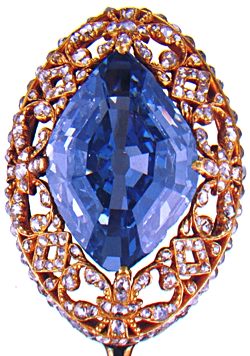
STICKPINRUSSIA, CIRCA I800Gold, silver, blue diamond (7. 6 carats), white diamonds (.96 carats) 1 x 3/4 in (2.6x 1.8 cm)The State Diamond Fund of the Russian FederationInv. No. AF-8
This pin features a blue diamond believed to have been cleft from the famed stone called "Le Tavernier" - the same stone as the Hope diamond. The stone, originally set as a ring for Empress Maria Feodorovna, wife of Emperor Paul I, was given to the Diamond Fund in 1860, by her daughter-in-law, the Empress Alexandra Feodorovna.
This pin features a blue diamond believed to have been cleft from the famed stone called "Le Tavernier" - the same stone as the Hope diamond. The stone, originally set as a ring for Empress Maria Feodorovna, wife of Emperor Paul I, was given to the Diamond Fund in 1860, by her daughter-in-law, the Empress Alexandra Feodorovna.
The Hope Diamond

The history of the stone which was eventually named the Hope diamond began when the French merchant traveller, Jean Baptiste Tavernier, purchased a 112 3/16-carat diamond. This diamond, which was most likely from the Kollur mine in Golconda, India, was somewhat triangular in shape and crudely cut. Its color was described by Tavernier as a "beautiful violet."
Tavernier sold the diamond to King Louis XIV of France in 1668 with 14 other large diamonds and several smaller ones. In 1673 the stone was recut by Sieur Pitau, the court jeweler, resulting in a 67 1/8-carat stone. In the royal inventories, its color was described as an intense steely-blue and the stone became known as the "Blue Diamond of the Crown," or the "French Blue." It was set in gold and suspended on a neck ribbon which the king wore on ceremonial occasions.
King Louis XV, in 1749, had the stone reset by court jeweler Andre Jacquemin, in a piece of ceremonial jewelry for the Order of the Golden Fleece (Toison D'Or). In 1791, after an attempt by Louis XVI and Marie Antoinette to flee France, the jewels of the French Royal Treasury were turned over to the government. During a week-long looting of the crown jewels in September of 1792, the French Blue diamond was stolen.
In 1812 a deep blue diamond described by John Francillion as weighing 177 grains (4 grains = 1 carat) was documented as being in the possession of London diamond merchant, Daniel Eliason. Strong evidence indicates that the stone was the recut French Blue and the same stone known today as the HopeDiamond. Several references suggest that it was acquired by King George IV of England. At his death, in 1830, the king's debts were so enormous that the blue diamond was likely sold through private channels.
The first reference to the diamond's next owner is found in the 1839 entry of the gem collection catalog of the well-known Henry Philip Hope, the man from whom the diamond takes its name. Unfortunately, the catalog does not reveal where or from whom Hope acquired the diamond or how much he paid for it.
Following the death of Henry Philip Hope in 1839, and after much litigation, the diamond passed to his nephew Henry Thomas Hope and ultimately to the nephew's grandson Lord Francis Hope. In 1901 Lord Francis Hope obtained permission from the Court of Chancery and his sisters to sell the stone to help pay off his debts. It was sold to a London dealer who quickly sold it to Joseph Frankels and Sons of New York City, who retained the stone in New York until they, in turn, needed cash. The diamond was next sold to Selim Habib who put it up for auction in Paris in 1909. It did not sell at the auction but was sold soon after to C.H. Rosenau and then resold to Pierre Cartier that same year.
In 1910 the Hope diamond was shown to Mrs. Evalyn Walsh McLean, of Washington D.C., at Cartier's in Paris, but she did not like the setting. Cartier had the diamond reset and took it to the U.S. where he left it with Mrs. McLean for a weekend. This strategy was successful. The sale was made in 1911 with the diamond mounted as a headpiece on a three-tiered circlet of large white diamonds. Sometime later it became the pendant on a diamond necklace as we know it today. Mrs. McLean's flamboyant ownership of the stone lasted until her death in 1947.
Harry Winston Inc. of New York City purchased Mrs. McLean's entire jewelry collection, including the Hope diamond, from her estate in 1949. This collection also included the 94.8-carat Star of the East diamond, the 15-carat Star of the South diamond, a 9-carat green diamond, and a 31-carat diamond which is now called the McLean diamond.
For the next 10 years the Hope diamond was shown at many exhibits and charitable events world wide by Harry Winston Inc., including as the central attraction of their Court of Jewels exhibition. On November 10, 1958, they donated the Hope diamond to the Smithsonian Institution, and almost immediately the great blue stone became its premier attraction.
The Hope diamond has left the Smithsonian only four times since it was donated. In 1962 it was exhibited for a month at the Louvre in Paris, France, as part of an exhibit entitled Ten Centuries of French Jewelry. In 1965 the Hope diamond traveled to South Africa where it was exhibited at the Rand Easter Show in Johannesburg. In 1984 the diamond was lent to Harry Winston Inc., in New York, as part of the firm's 50th anniversary celebration. In 1996 the Hope diamond was again sent to Harry Winston Inc., in New York, this time for cleaning and some minor restoration work.
The weight of the Hope diamond for many years was reported to be 44.5 carats. In 1974 it was removed from its setting and found actually to weigh 45.52 carats. It is classified as a type IIb diamond, which are semiconductive and usually phosphoresce. The Hope diamond phosphoresces a strong red color, which will last for several seconds after exposure to short wave ultra-violet light. The diamond's blue coloration is attributed to trace amounts of boron in the stone.
In the pendant surrounding the Hope diamond are 16 white diamonds, both pear-shapes and cushion cuts. A bail is soldered to the pendant where Mrs. McLean would often attach other diamonds including the McLean diamond and the Star of the East. The necklace chain contains 45 white diamonds.
Tavernier sold the diamond to King Louis XIV of France in 1668 with 14 other large diamonds and several smaller ones. In 1673 the stone was recut by Sieur Pitau, the court jeweler, resulting in a 67 1/8-carat stone. In the royal inventories, its color was described as an intense steely-blue and the stone became known as the "Blue Diamond of the Crown," or the "French Blue." It was set in gold and suspended on a neck ribbon which the king wore on ceremonial occasions.
King Louis XV, in 1749, had the stone reset by court jeweler Andre Jacquemin, in a piece of ceremonial jewelry for the Order of the Golden Fleece (Toison D'Or). In 1791, after an attempt by Louis XVI and Marie Antoinette to flee France, the jewels of the French Royal Treasury were turned over to the government. During a week-long looting of the crown jewels in September of 1792, the French Blue diamond was stolen.
In 1812 a deep blue diamond described by John Francillion as weighing 177 grains (4 grains = 1 carat) was documented as being in the possession of London diamond merchant, Daniel Eliason. Strong evidence indicates that the stone was the recut French Blue and the same stone known today as the HopeDiamond. Several references suggest that it was acquired by King George IV of England. At his death, in 1830, the king's debts were so enormous that the blue diamond was likely sold through private channels.
The first reference to the diamond's next owner is found in the 1839 entry of the gem collection catalog of the well-known Henry Philip Hope, the man from whom the diamond takes its name. Unfortunately, the catalog does not reveal where or from whom Hope acquired the diamond or how much he paid for it.
Following the death of Henry Philip Hope in 1839, and after much litigation, the diamond passed to his nephew Henry Thomas Hope and ultimately to the nephew's grandson Lord Francis Hope. In 1901 Lord Francis Hope obtained permission from the Court of Chancery and his sisters to sell the stone to help pay off his debts. It was sold to a London dealer who quickly sold it to Joseph Frankels and Sons of New York City, who retained the stone in New York until they, in turn, needed cash. The diamond was next sold to Selim Habib who put it up for auction in Paris in 1909. It did not sell at the auction but was sold soon after to C.H. Rosenau and then resold to Pierre Cartier that same year.
In 1910 the Hope diamond was shown to Mrs. Evalyn Walsh McLean, of Washington D.C., at Cartier's in Paris, but she did not like the setting. Cartier had the diamond reset and took it to the U.S. where he left it with Mrs. McLean for a weekend. This strategy was successful. The sale was made in 1911 with the diamond mounted as a headpiece on a three-tiered circlet of large white diamonds. Sometime later it became the pendant on a diamond necklace as we know it today. Mrs. McLean's flamboyant ownership of the stone lasted until her death in 1947.
Harry Winston Inc. of New York City purchased Mrs. McLean's entire jewelry collection, including the Hope diamond, from her estate in 1949. This collection also included the 94.8-carat Star of the East diamond, the 15-carat Star of the South diamond, a 9-carat green diamond, and a 31-carat diamond which is now called the McLean diamond.
For the next 10 years the Hope diamond was shown at many exhibits and charitable events world wide by Harry Winston Inc., including as the central attraction of their Court of Jewels exhibition. On November 10, 1958, they donated the Hope diamond to the Smithsonian Institution, and almost immediately the great blue stone became its premier attraction.
The Hope diamond has left the Smithsonian only four times since it was donated. In 1962 it was exhibited for a month at the Louvre in Paris, France, as part of an exhibit entitled Ten Centuries of French Jewelry. In 1965 the Hope diamond traveled to South Africa where it was exhibited at the Rand Easter Show in Johannesburg. In 1984 the diamond was lent to Harry Winston Inc., in New York, as part of the firm's 50th anniversary celebration. In 1996 the Hope diamond was again sent to Harry Winston Inc., in New York, this time for cleaning and some minor restoration work.
The weight of the Hope diamond for many years was reported to be 44.5 carats. In 1974 it was removed from its setting and found actually to weigh 45.52 carats. It is classified as a type IIb diamond, which are semiconductive and usually phosphoresce. The Hope diamond phosphoresces a strong red color, which will last for several seconds after exposure to short wave ultra-violet light. The diamond's blue coloration is attributed to trace amounts of boron in the stone.
In the pendant surrounding the Hope diamond are 16 white diamonds, both pear-shapes and cushion cuts. A bail is soldered to the pendant where Mrs. McLean would often attach other diamonds including the McLean diamond and the Star of the East. The necklace chain contains 45 white diamonds.
Cultured Diamonds Won’t Match Up
There is a lot of controversy around the cultured diamond. These diamonds are synthetic, or in other words, not naturally made. While experts can tell them apart from real diamonds, experts do believe that they can be helpful when added to the industry. Synthetic diamonds are diamond crystals that have been produced by a very complex, technological process. In short, this method is a geological process done by man. At a recent diamond conference held in Europe, the topic of cultured diamonds came up. The leading investment and corporate leaders in the industry talked about the effects that the cultured diamond would have on the markets. The key is that they did not say the diamond would cause the natural occurring diamond’s prices to fall. Rather, they believe that the synthetic formed diamonds will in fact help to provide some solution to the problem of demand, which the diamond industry has had a difficult time keeping up with. Yet, in the same breath, these experts say that they believe that the public will always seek out the true diamonds..
Understanding Synthetic Diamonds
There are benefits to the diamond industry in terms of cultured diamonds. These diamonds can be in production for a far less price, much less than the cost of mining natural diamonds and then processing them. These diamonds can be in use in many of the same situations that natural diamonds will work in. The fact that engineers can actually make diamonds like this has been a way to help provide real diamonds (though cultured) to the public at a lower price, allowing more people than ever to be able to enjoy them.
The concern since the beginning of the process of producing cultured diamonds has not changed. The belief is that if manufacturing diamonds through technology is less expensive and it produces a quality product, the value of real diamonds would drop, and drop quite quickly.
In 1797, it was a discovery that diamonds were in fact made of pure carbon, a product readily available. Since that time, there has been an incredible amount of attempts at manufacturing the synthetic diamond. In most early cases, the process was difficult and it often resulted in failure. While the project failed repeatedly, it wasn’t until 1941 that a true effort, called the GE Diamond Project, was undertaking. During that project, experts from several leading companies were able to heat carbon to 3000 degrees C and under an extreme amount of pressure (half a million psi) for a short amount of time. The first diamond came about in 1954. It was complete through experiments and trial and error. Through time, this method would also change.
The Current Questions
Over time, the development of cultured diamonds has been able to be improved so much so that it has gotten to the point of being economical to do. The process does not take as much time as it once did and the overall process has improved in safety, costs and overall acceptable diamond results. Cultured diamonds are chemically as well as structurally the same as naturally found diamonds.
At the diamond conference that occurred, experts talked about what the cultured diamond would do for the industry. The problem that most see is that the supply of rough gems that is currently available is likely to fall short of the demand for it. In the next five to seven years, there is a risk that there simply will not be enough diamonds to be readily available for sale to match the demand. In a way, the cultured diamond would help to extinguish some of the demand from now until then and after that period happens as well.
Although they will fill this need, experts at the conference believe that the culture diamond will be just that, a substitution that will not replace the authentic diamond, and the natural diamond will not lose its value in the process. They believe that a cultured diamond, while just as beautiful and as unique, will be unable to compete with the natural diamond.
The executives, leaders and company professionals that attended the conference were able to show that the diamond industry is likely to accept the cultured diamond as a valuable asset and it will be in use to help keep the supply of diamonds high enough to meet demand, but it will never take the place of a true, mined diamond. One executive compared the cultured diamond to the Californian wine makers who produce fine quality wine that does not come from France. While both are in demand, they are not directly competition with each other as the same product as is with the diamonds.
Understanding Synthetic Diamonds
There are benefits to the diamond industry in terms of cultured diamonds. These diamonds can be in production for a far less price, much less than the cost of mining natural diamonds and then processing them. These diamonds can be in use in many of the same situations that natural diamonds will work in. The fact that engineers can actually make diamonds like this has been a way to help provide real diamonds (though cultured) to the public at a lower price, allowing more people than ever to be able to enjoy them.
The concern since the beginning of the process of producing cultured diamonds has not changed. The belief is that if manufacturing diamonds through technology is less expensive and it produces a quality product, the value of real diamonds would drop, and drop quite quickly.
In 1797, it was a discovery that diamonds were in fact made of pure carbon, a product readily available. Since that time, there has been an incredible amount of attempts at manufacturing the synthetic diamond. In most early cases, the process was difficult and it often resulted in failure. While the project failed repeatedly, it wasn’t until 1941 that a true effort, called the GE Diamond Project, was undertaking. During that project, experts from several leading companies were able to heat carbon to 3000 degrees C and under an extreme amount of pressure (half a million psi) for a short amount of time. The first diamond came about in 1954. It was complete through experiments and trial and error. Through time, this method would also change.
The Current Questions
Over time, the development of cultured diamonds has been able to be improved so much so that it has gotten to the point of being economical to do. The process does not take as much time as it once did and the overall process has improved in safety, costs and overall acceptable diamond results. Cultured diamonds are chemically as well as structurally the same as naturally found diamonds.
At the diamond conference that occurred, experts talked about what the cultured diamond would do for the industry. The problem that most see is that the supply of rough gems that is currently available is likely to fall short of the demand for it. In the next five to seven years, there is a risk that there simply will not be enough diamonds to be readily available for sale to match the demand. In a way, the cultured diamond would help to extinguish some of the demand from now until then and after that period happens as well.
Although they will fill this need, experts at the conference believe that the culture diamond will be just that, a substitution that will not replace the authentic diamond, and the natural diamond will not lose its value in the process. They believe that a cultured diamond, while just as beautiful and as unique, will be unable to compete with the natural diamond.
The executives, leaders and company professionals that attended the conference were able to show that the diamond industry is likely to accept the cultured diamond as a valuable asset and it will be in use to help keep the supply of diamonds high enough to meet demand, but it will never take the place of a true, mined diamond. One executive compared the cultured diamond to the Californian wine makers who produce fine quality wine that does not come from France. While both are in demand, they are not directly competition with each other as the same product as is with the diamonds.
Namibian Diamond Mining Discovers Sunken Treasure

Posted By Malcom in Precious Metals and Gemstones
On April 1st, 2008, Namdeb, the Namibian mining company that represents a diamond mining partnership between the Namibian government and the DeBeers Diamond Company, discovered something other than diamonds. While searching the seabed off of Namibia’s desert coastal region, they stumbled upon some copper ingots. Momentarily halting their search for diamonds in the diamond-rich Namibian seabed area, the mining operation discovered cannons and ivory tusks along with a large quantity of gold and silver coins.
The company’s geologists immediately contacted the archaeologist Dieter Noli, who has been working with DeBeers to investigate the areas that Namdeb has been digging in search of diamonds. Once Noli had investigated the site, he was able to ascertain that the finds were the result of a long-ago deteriorated shipwreck. He has estimated that the wreck occurred at some point during the late 15th or early 16th century, around the same time period that investigation into the new world was beginning.
Noli primarily studies the desert regions of Namibia, but had prepared himself for a while for coastal archaeology. The coastal region of the Namibia region of Africa is known for rough waters as well as fogs and other sea dangers. For this reason, Noli felt that it would be just a matter of time before a wreck of the nature that has been discovered would be found. He had even gone as far as learning to dive in preparation for what he saw to be an eventual research opportunity.
The coins that were found were cast in Spain and Portugal. The dating of the coins puts them at the time period that Spain and Portuguese shipping ruled the seas. While the New World was just entering the period of discovery and exploration at the time the ship is dated to, the African continent was also beginning to receive greater exploration for land and resources. In short, it would not have been unusual for a ship of that time period to be carrying such a large quantity of treasure off the coast of southern Africa.
Namdeb made the press announcement of the shipwreck discovery on Wednesday, April 30th. At this time, Noli stated that he should be able to discover the identity of the craft and its captain through visits to Spain and Portugal. The quantity of high-value goods - such as ivory, gold and silver coins - while not unusual for a trading vessel of either the Spanish or Portuguese crowns, would have careful records stating its port-of-call, captain, mission, and list of goods at the time of it leaving port.
Noli has also stated that it is possible that the ship may have been a pirate ship. This would explain the large quantity of coins found along with the ivory. A legal trading vessel would most likely have one or the other, as the coins would most likely have been utilized to pay for the ivory. He has also theorized that it is possible that the captain was particularly fortunate during his trading for the ivory, and so was able to retain the large quantity of coins that have been found with the ivory stores.
The dating of the shipwreck came from a number of artifacts found in the wreckage. The only navigational devices found were astrolabes, a typical navigational tool used on ships from the 15th to the 17th century. The astrolabes were used only to identify where a ship was in regards to its northern or southern location, not its eastern or western location. The cannons that were found have been identified as having been made in Spain during the late 15th or 16th century. Coins dated as 15th century and pewter tableware added to the artifacts lending to the dating of the wreckage.
There is some early speculation as to the identification of the captain of the vessel. Bartolomeu Dias was a Portuguese explorer of the late 15th century, and disappeared in 1500. He had been the first European to have successfully navigated the Cape of Good Hope around the southern tip of Africa on his way to discover an alternative trade route to Asia as opposed to the routes that at that time went through the Middle East. It was in 1488 that he discovered the Cape of Good Hope, but it was 12 years later, during further expeditions in the same area that his ship disappeared in a storm off of the Cape of Good Hope.
Whether or not the final resting place of Bartolomeu Dias’ final voyage over 500 years ago has been discovered by a modern diamond mining company will only be known through further research. However, even if it is not Dias’ ship, Namdeb may have found an African-waters shipwreck that is older than any other in the Sub-Saharan region. This shipwreck is proving to be quite a different type of diamond-in-the-rough than Namdeb is used to dealing with.
Related Posts:
The Reality of Offshore Diamond Mining
Mining for Treasures at Sea
The Real Value of Diamonds in Namibia
Leave a Reply
Name (required)
Mail (will not be published) (required)
Website
The World of Pink Diamonds

When most people hear the word “diamond”, they immediately think of a clear stone, one with brilliance and shine. However, in addition to the traditional diamond, the type that is most often seen in engagement rings, pendants, and earrings, there are also colored diamonds. These diamonds are also stunning but because they are rarer, the price is typically higher.
One of the most popular colored diamonds is the pink stone. Although these diamonds can be mined in a number of countries, finding them is difficult. Because of that, pink diamonds are limited. One of the countries that produce the largest number of pink diamonds, as well as being the oldest for mining this stone, is India. In fact, many of the diamond deposits coming out of India have a beautiful pastel color.
Other countries, in which the pink diamond is mined is South Africa, Brazil, and Australia. Close to Lake Argyle in Australia, which is in the north west part of the country, pink diamonds were first discovered in the late 1970s. As mining efforts increased, it has been discovered that Australia is actually a great place to find a large and consistent supply of these gorgeous stones.
Without doubt, pink diamonds are rare and for this color to develop, there are several factors involved. For instance, some experts in the diamond industry state that extreme geological forces being placed on the stone once it has been formed is what causes the stone to turn pink. In addition, with the pressure and heat applied to the stone, even the diamond structure is unique.
Now, when people shop for pink diamonds, they need to understand that finding a stone that is completely pink is extremely unusual. When these diamonds are looked at through a professional device, it is found that while pink seems to be the primary color, hues of brown, purple, and orange also appear.
When it comes to pink diamonds there are two types, both that are created naturally. First, there is the Type Ia, which is what most pink diamonds are rated. In addition, the pink diamonds in the first category are found to have small amounts of nitrogen. Then, there is Type IIa. With this second category, the pink diamonds are virtually nitrogen free and finding those of this type is hard, making them the rarest.
A fact that many people are unaware of is that creating pink diamonds is nothing new. The original process used to create a pink diamond is called painting. With this, foil is added to the back of the diamond to turn it into whatever color the person wants. However, with new techniques and equipment, painting is a thing of the past.
If a person wanted a pink diamond but could not afford the higher price, they could still end up with a diamond that looks pink. The process used today is durable and long lasting. In fact, the process is so sophisticated, that it is near impossible to tell that the stone has been treated rather than being a real mined pink diamond. The only thing is that if a gemologist or jeweler uses any process of adding or changing the color of a diamond, by law, he or she is required to disclose the information to the buyer.
Typically, a process known as high-pressure, high-temperature or HPHT is used, which will take a diamond and enhance its color. Additionally, diamonds that have color, such as the mined pink diamonds of Type IIa, which have several colors, hues can be removed. The result is that a person can have diamonds customized to their liking.
While the real pink diamonds are the ones in demand, people can also consider buying synthetic stones. Although these stones are real diamonds, they are clear. However, with new processes, they look amazingly good. For instance, with the pink diamond, HPHT growth machines are used along with CVD or Chemical Vapor Deposition. The process actually incorporates nitrogen impurities into the stone, which add color, and then that color is enhanced.
Pink diamonds have long been a desired stone but in the past several years, their popularity has skyrocketed. More and more, people are interested in something unique, a diamond with character and personality. Because of this, there has been an increase in princess cut stones, antique settings, and colored stones, especially the pink diamond.
Since these stones are so rare, collectors also have a high interest in them. As mentioned, pink diamonds are mined in many countries but they are very rare. For anyone interested in buying this type of diamond, it is imperative that she or he work with a licensed and reputable broker or seller. Otherwise, the individual might pay good money only to find out they purchased a synthetic pink diamond, not the real thing. The seller of pink diamonds should be able to provide specific information as to where the diamond was mined, as well as certification that the stone is as stated.
One of the most popular colored diamonds is the pink stone. Although these diamonds can be mined in a number of countries, finding them is difficult. Because of that, pink diamonds are limited. One of the countries that produce the largest number of pink diamonds, as well as being the oldest for mining this stone, is India. In fact, many of the diamond deposits coming out of India have a beautiful pastel color.
Other countries, in which the pink diamond is mined is South Africa, Brazil, and Australia. Close to Lake Argyle in Australia, which is in the north west part of the country, pink diamonds were first discovered in the late 1970s. As mining efforts increased, it has been discovered that Australia is actually a great place to find a large and consistent supply of these gorgeous stones.
Without doubt, pink diamonds are rare and for this color to develop, there are several factors involved. For instance, some experts in the diamond industry state that extreme geological forces being placed on the stone once it has been formed is what causes the stone to turn pink. In addition, with the pressure and heat applied to the stone, even the diamond structure is unique.
Now, when people shop for pink diamonds, they need to understand that finding a stone that is completely pink is extremely unusual. When these diamonds are looked at through a professional device, it is found that while pink seems to be the primary color, hues of brown, purple, and orange also appear.
When it comes to pink diamonds there are two types, both that are created naturally. First, there is the Type Ia, which is what most pink diamonds are rated. In addition, the pink diamonds in the first category are found to have small amounts of nitrogen. Then, there is Type IIa. With this second category, the pink diamonds are virtually nitrogen free and finding those of this type is hard, making them the rarest.
A fact that many people are unaware of is that creating pink diamonds is nothing new. The original process used to create a pink diamond is called painting. With this, foil is added to the back of the diamond to turn it into whatever color the person wants. However, with new techniques and equipment, painting is a thing of the past.
If a person wanted a pink diamond but could not afford the higher price, they could still end up with a diamond that looks pink. The process used today is durable and long lasting. In fact, the process is so sophisticated, that it is near impossible to tell that the stone has been treated rather than being a real mined pink diamond. The only thing is that if a gemologist or jeweler uses any process of adding or changing the color of a diamond, by law, he or she is required to disclose the information to the buyer.
Typically, a process known as high-pressure, high-temperature or HPHT is used, which will take a diamond and enhance its color. Additionally, diamonds that have color, such as the mined pink diamonds of Type IIa, which have several colors, hues can be removed. The result is that a person can have diamonds customized to their liking.
While the real pink diamonds are the ones in demand, people can also consider buying synthetic stones. Although these stones are real diamonds, they are clear. However, with new processes, they look amazingly good. For instance, with the pink diamond, HPHT growth machines are used along with CVD or Chemical Vapor Deposition. The process actually incorporates nitrogen impurities into the stone, which add color, and then that color is enhanced.
Pink diamonds have long been a desired stone but in the past several years, their popularity has skyrocketed. More and more, people are interested in something unique, a diamond with character and personality. Because of this, there has been an increase in princess cut stones, antique settings, and colored stones, especially the pink diamond.
Since these stones are so rare, collectors also have a high interest in them. As mentioned, pink diamonds are mined in many countries but they are very rare. For anyone interested in buying this type of diamond, it is imperative that she or he work with a licensed and reputable broker or seller. Otherwise, the individual might pay good money only to find out they purchased a synthetic pink diamond, not the real thing. The seller of pink diamonds should be able to provide specific information as to where the diamond was mined, as well as certification that the stone is as stated.
Famous People and Their Love of Diamonds
People have long heard the words, “A diamond is forever“, which it is. Throughout history, many rich and famous people have wowed the public with amazing diamonds, rings, bracelets, necklaces, earrings, tiaras, and more. Without doubt, famous people have a significant love for diamonds, creating a fairytale that the majority of people can only appreciate from afar.
Although diamond engagement rings are a normal part of today’s society, the first engagement ring was actually documented in 1477. In medieval Europe, Maximilian I of Austria had an amazing diamond ring created for Mary of Burgundy, his future wife. Today, people can learn more about this ring, as well as the couple’s happy marriage in a book entitled, Book of Hours.
Then in 1953, which was known as the “wedding of the year”, the future John F. Kennedy married Jacqueline. Her diamond engagement ring was a full two carat stone designed with an emerald. The contrast in stones was stunning and responsible for many other people using a variety of stones in an engagement ring. Her engagement ring along with the gorgeous, cream colored taffeta gown and rose point lace veil, as well as her pearl and diamond bracelet made her one of the most spectacular weddings of all time.
Another famous diamond was the 12 carat, emerald cut diamond engagement ring offered to Grace Kelly by her future husband, the Prince of Monaco, Rainier. In fact, Grace Kelly was so enthralled with her ring that she would go on to wear it in her 1956 High Society film. At that time, it is stated that Bing Crosby approached her and looking at the ring stated, “Some stone - did you mine it yourself?” To complement her diamond engagement ring, the Prince gave her a beautiful pre-wedding gift of a diamond and pearl necklace, earring, and bracelet set by the famous designer, Fan Cleef and Arpel.
Of course, the King of rock and roll, Elvis Presley also ranks high in his choice of diamonds given to his bride, Priscilla. The diamond ring had a 3.5 carat center encased with 21 additional but smaller diamonds.
Sharon Osbourne is another famous person who loves diamonds, many given to her by her rocker husband, Ozzy. The interesting thing about her choices in diamond jewelry is that she prefers a more whimsical look, which includes her famous diamond bow tie necklace.
Madonna and Brittany Spears are two people who also take diamonds to an entirely new and fun level. For instance, both wore a pave diamond initial necklace valued around $13,000 when they presented at the 2003 MTV music awards. Since that time, people have shown tremendous interest in owning their own diamond initial necklace such as those designed by Neil Lane.
Even people that are unpretentious love diamonds. Take Jennifer Aniston as a prime example. She is a simple person but someone who has incredible taste. The great thing about diamonds worn by Jennifer is that they are so diverse from whimsical to chic to elegant. For instance, when Jennifer attended The Good Girl premier, she wore a gorgeous circle disk necklace. However, it was her engagement ring from Brad Pitt, designed by him, that was so spectacular. Made from white gold with 20 diamonds encircling it and with names engraved on the inside, this ring also became a loved style that other people copied.
Halle Berry - For the 60th Golden Globe Awards, Halle complemented her ice blue evening gown with more than $5 millions of diamonds, blue and white. In fact, one was a 26-carat diamond ring coupled with a 30-carat, pear shaped pendant, all beautifully designed by the renowned Harry Winston.
Bonnie Hunt is another celebrity that wears diamonds well. For example, one of the most incredible pieces of diamond jewelry worn was another design by Harry Winston, which included diamond earrings worth $40,000 and a flower diamond bracelet valued at $30,000.
Queen Latifa is not one that flaunts diamonds but she did have a show stopper when she proudly wore a 73-carat diamond necklace and matching earrings of Chopard designs.
Of course, many celebrities and famous people wear fabulous and rare diamonds while on the red carpet for main events. Some of the most gorgeous diamonds were worn by Penelope Cruz, Kathy Griffin, and Cate Blanchett.
Some of the most popular diamond jewelry includes chandelier earrings, which are common on the red carpet, specifically for the Academy and Golden Globe Awards.
While diamond jewelry is the most common thing people think of when they think of diamonds, there have been other designs to include the 2002, $1 million Oscar shoes worn by Laura Elena Herring. These amazing shoes were the design of Stuart Weitzman, which were created with 464 diamonds, two, 5-carat pear shaped diamonds, and two, 1.5 round shaped diamonds, all on shoes made from spun platinum.
Even the Oscar diamond gown worth $5 million would be hard to beat. Worn by Jules Asner, this gown was created with 5,000, .25-carat diamonds called “Hearts of Fire”.
Although diamond engagement rings are a normal part of today’s society, the first engagement ring was actually documented in 1477. In medieval Europe, Maximilian I of Austria had an amazing diamond ring created for Mary of Burgundy, his future wife. Today, people can learn more about this ring, as well as the couple’s happy marriage in a book entitled, Book of Hours.
Then in 1953, which was known as the “wedding of the year”, the future John F. Kennedy married Jacqueline. Her diamond engagement ring was a full two carat stone designed with an emerald. The contrast in stones was stunning and responsible for many other people using a variety of stones in an engagement ring. Her engagement ring along with the gorgeous, cream colored taffeta gown and rose point lace veil, as well as her pearl and diamond bracelet made her one of the most spectacular weddings of all time.
Another famous diamond was the 12 carat, emerald cut diamond engagement ring offered to Grace Kelly by her future husband, the Prince of Monaco, Rainier. In fact, Grace Kelly was so enthralled with her ring that she would go on to wear it in her 1956 High Society film. At that time, it is stated that Bing Crosby approached her and looking at the ring stated, “Some stone - did you mine it yourself?” To complement her diamond engagement ring, the Prince gave her a beautiful pre-wedding gift of a diamond and pearl necklace, earring, and bracelet set by the famous designer, Fan Cleef and Arpel.
Of course, the King of rock and roll, Elvis Presley also ranks high in his choice of diamonds given to his bride, Priscilla. The diamond ring had a 3.5 carat center encased with 21 additional but smaller diamonds.
Sharon Osbourne is another famous person who loves diamonds, many given to her by her rocker husband, Ozzy. The interesting thing about her choices in diamond jewelry is that she prefers a more whimsical look, which includes her famous diamond bow tie necklace.
Madonna and Brittany Spears are two people who also take diamonds to an entirely new and fun level. For instance, both wore a pave diamond initial necklace valued around $13,000 when they presented at the 2003 MTV music awards. Since that time, people have shown tremendous interest in owning their own diamond initial necklace such as those designed by Neil Lane.
Even people that are unpretentious love diamonds. Take Jennifer Aniston as a prime example. She is a simple person but someone who has incredible taste. The great thing about diamonds worn by Jennifer is that they are so diverse from whimsical to chic to elegant. For instance, when Jennifer attended The Good Girl premier, she wore a gorgeous circle disk necklace. However, it was her engagement ring from Brad Pitt, designed by him, that was so spectacular. Made from white gold with 20 diamonds encircling it and with names engraved on the inside, this ring also became a loved style that other people copied.
Halle Berry - For the 60th Golden Globe Awards, Halle complemented her ice blue evening gown with more than $5 millions of diamonds, blue and white. In fact, one was a 26-carat diamond ring coupled with a 30-carat, pear shaped pendant, all beautifully designed by the renowned Harry Winston.
Bonnie Hunt is another celebrity that wears diamonds well. For example, one of the most incredible pieces of diamond jewelry worn was another design by Harry Winston, which included diamond earrings worth $40,000 and a flower diamond bracelet valued at $30,000.
Queen Latifa is not one that flaunts diamonds but she did have a show stopper when she proudly wore a 73-carat diamond necklace and matching earrings of Chopard designs.
Of course, many celebrities and famous people wear fabulous and rare diamonds while on the red carpet for main events. Some of the most gorgeous diamonds were worn by Penelope Cruz, Kathy Griffin, and Cate Blanchett.
Some of the most popular diamond jewelry includes chandelier earrings, which are common on the red carpet, specifically for the Academy and Golden Globe Awards.
While diamond jewelry is the most common thing people think of when they think of diamonds, there have been other designs to include the 2002, $1 million Oscar shoes worn by Laura Elena Herring. These amazing shoes were the design of Stuart Weitzman, which were created with 464 diamonds, two, 5-carat pear shaped diamonds, and two, 1.5 round shaped diamonds, all on shoes made from spun platinum.
Even the Oscar diamond gown worth $5 million would be hard to beat. Worn by Jules Asner, this gown was created with 5,000, .25-carat diamonds called “Hearts of Fire”.
The Top Ten of the Diamond World
When thinking about diamonds most people don’t think of a rainbow of color, with every hue or shade possible, but actually diamonds come naturally in over three hundred possible colors. They range from “pumpkin” orange, to pale pink and “canary” yellow. In fact, some of the world’s most well-known and largest stones are not clear, glass-like examples of a diamond, but enormous colored gems.In the history of diamonds there are ten on record that weigh more than two hundred carats each. Some belong to royal families, governments and private individuals. Some have passed from public notoriety into complete secrecy, and some have even been used to do good deeds. They all come from different sources, and some have a great deal of mystery attached to their origins, but they are all remarkable for their size and notoriety.
The world’s largest known diamond belongs to the King of Thailand. It was presented to him in 1997 as a special gift on the occasion of his fiftieth anniversary as the king. The “Golden Jubilee” diamond is five hundred and forty five carats in weight, but it was cut from a staggering seven hundred and fifty five carat stone. This brown colored diamond has an estimated value of over twelve million dollars.
Coming in at only fifteen carats smaller is the second largest known diamond - the “Star of Africa” also known as the “Cullinan I”. This colorless diamond is actually one of nine pieces originating from the Cullinan Diamond, a three thousand one hundred and six carat stone discovered in Africa in 1905. The entire stone was presented to King Edward VII of England in 1908, where it was cut into the nine pieces that are now part of the royal family’s jewel collection. The Star of Africa usually resides in the Royal Scepter, but it can also be worn as a pin or pendant.
Another brown diamond fills in the top five of the world’s largest diamonds; the “Incomparable” was discovered at some point in the 1980s. It is considered to be a “fancy brown-yellow” which means its clarity and color are of the highest quality. The stone, when found, was over eight hundred and ninety carats, but after four years of expert analysis and planning it was formally cut to a four hundred and seven carat, faceted stone. Interestingly, the diamond also has the claim of the highest priced gem to go up for public auction on the internet, where it failed to sell in 2002.
The fourth largest diamond is also the second largest piece of the famous Cullinan Diamond. The “Cullinan II” rests in the Imperial State Crown of Great Britain, where it has also been fitted out with clasps that allow it to be worn as a pin or pendant. Though a smaller “sibling” to the Star of Africa, the Cullinan II diamond still carries an impressive three hundred seventeen carats in weight. It too is continually housed with jewels and gems belonging to the British Royal Family.
The colored diamonds once again distinguish themselves in the top five of the world’s largest stones, this time with a black diamond known as the “Spirit of de Grisogono“. This diamond is also the world’s largest black diamond, a three hundred and twelve carat monster set into a remarkable white gold ring mounting. This diamond is in private ownership.
Over a year was spent cutting the sixth largest diamond in the world - the colorless or white “Centenary” diamond. Its initial weight was around six hundred carats, but by the time the cutting was completed the stone still weighed in at an impressive two hundred and seventy three carats. The stone was discovered in the late 1980s in Africa, and though the owner is unknown, at its last appraisal in 1991 it was insured for over one hundred million dollars.
A two hundred and forty five carat whopper is the seventh largest diamond on record. The “Jubilee” was intended for Queen Victoria on the occasion of her seventy-fifth year as Queen of England. Unfortunately, she never received the diamond because the stone’s owners realized the enormous value of the diamond when they examined it for cutting. The experience of cutting the stone however did introduce the “jubilee” style of cut into the world of diamonds.
A stone noted for its size, but whose whereabouts are currently unknown is the eighth largest diamond - the “DeBeers”. Originally a four hundred and twenty eight carat light yellow stone, it was reduced to two hundred and thirty four carats before being set into the famous Patiala Necklace in 1928.
Winding down the list of the world’s top ten largest diamonds is the two hundred and five carat “Red Cross”. Unique because of its size, canary yellow color, and the appearance of a “Maltese Cross” within the top facet, the stone was auctioned on behalf of the British Red Cross Society in 1918.
Finally, the tenth largest diamond on record is the “Millennium Star,” a completely flawless blue diamond that originates from a more than seven hundred carat stone. Months of analysis and planning were done before any cuts were made, and three large stones were the result. Though the diamond is not likely to enter the market, estimates place its worth at over one hundred million English pounds.
The world’s largest known diamond belongs to the King of Thailand. It was presented to him in 1997 as a special gift on the occasion of his fiftieth anniversary as the king. The “Golden Jubilee” diamond is five hundred and forty five carats in weight, but it was cut from a staggering seven hundred and fifty five carat stone. This brown colored diamond has an estimated value of over twelve million dollars.
Coming in at only fifteen carats smaller is the second largest known diamond - the “Star of Africa” also known as the “Cullinan I”. This colorless diamond is actually one of nine pieces originating from the Cullinan Diamond, a three thousand one hundred and six carat stone discovered in Africa in 1905. The entire stone was presented to King Edward VII of England in 1908, where it was cut into the nine pieces that are now part of the royal family’s jewel collection. The Star of Africa usually resides in the Royal Scepter, but it can also be worn as a pin or pendant.
Another brown diamond fills in the top five of the world’s largest diamonds; the “Incomparable” was discovered at some point in the 1980s. It is considered to be a “fancy brown-yellow” which means its clarity and color are of the highest quality. The stone, when found, was over eight hundred and ninety carats, but after four years of expert analysis and planning it was formally cut to a four hundred and seven carat, faceted stone. Interestingly, the diamond also has the claim of the highest priced gem to go up for public auction on the internet, where it failed to sell in 2002.
The fourth largest diamond is also the second largest piece of the famous Cullinan Diamond. The “Cullinan II” rests in the Imperial State Crown of Great Britain, where it has also been fitted out with clasps that allow it to be worn as a pin or pendant. Though a smaller “sibling” to the Star of Africa, the Cullinan II diamond still carries an impressive three hundred seventeen carats in weight. It too is continually housed with jewels and gems belonging to the British Royal Family.
The colored diamonds once again distinguish themselves in the top five of the world’s largest stones, this time with a black diamond known as the “Spirit of de Grisogono“. This diamond is also the world’s largest black diamond, a three hundred and twelve carat monster set into a remarkable white gold ring mounting. This diamond is in private ownership.
Over a year was spent cutting the sixth largest diamond in the world - the colorless or white “Centenary” diamond. Its initial weight was around six hundred carats, but by the time the cutting was completed the stone still weighed in at an impressive two hundred and seventy three carats. The stone was discovered in the late 1980s in Africa, and though the owner is unknown, at its last appraisal in 1991 it was insured for over one hundred million dollars.
A two hundred and forty five carat whopper is the seventh largest diamond on record. The “Jubilee” was intended for Queen Victoria on the occasion of her seventy-fifth year as Queen of England. Unfortunately, she never received the diamond because the stone’s owners realized the enormous value of the diamond when they examined it for cutting. The experience of cutting the stone however did introduce the “jubilee” style of cut into the world of diamonds.
A stone noted for its size, but whose whereabouts are currently unknown is the eighth largest diamond - the “DeBeers”. Originally a four hundred and twenty eight carat light yellow stone, it was reduced to two hundred and thirty four carats before being set into the famous Patiala Necklace in 1928.
Winding down the list of the world’s top ten largest diamonds is the two hundred and five carat “Red Cross”. Unique because of its size, canary yellow color, and the appearance of a “Maltese Cross” within the top facet, the stone was auctioned on behalf of the British Red Cross Society in 1918.
Finally, the tenth largest diamond on record is the “Millennium Star,” a completely flawless blue diamond that originates from a more than seven hundred carat stone. Months of analysis and planning were done before any cuts were made, and three large stones were the result. Though the diamond is not likely to enter the market, estimates place its worth at over one hundred million English pounds.
Famous, Infamous and Unusual Diamonds

History shows that most “objects” of any value tend to cause trouble. Wars occur over land, oil, water or other items that have a specific value at a specific point in time. People fight over possessions, money and material goods as well, and one item that has a long history of controversy and material value is the diamond.Even the stone’s name comes from ancient times, when the Greeks called them “adamas” (the unconquerable). The strength and durability of a diamond was quickly recognized, and soon it was regularly seen on the leather “armor” of royalty, more as an amulet of protection than as an actual barrier against physical harm. Soon however, the beauty of diamonds for ornaments was recognized and royals began crafting elaborate crowns and ornamental jewelry.
With the coming of the modern era, diamonds began to be available to common or “everyday” people, and are now a symbol of love, wealth and glamour. Historically however there have been a few diamonds that earned themselves a reputation as bringers of bad luck, ill fortune or even disaster. Beginning in the nineteenth century popular stories of troublesome diamonds began to appear.
Of course, one of the most well-known stories of a “cursed” diamond is the famous “Hope Diamond“. Though this lovely blue stone is not the largest diamond in the world, its story rivals any epic tale or saga. Its origins are not known, but it is rumored to have originally been a piece of the legendary “Blue Tavernier Diamond” which appeared in Europe in the mid 1600s. The stone was rumored to have come from India, and was purchased by France’s King Louis XIV. He had his court jewelers cut the stone to a more “manageable” sixty eight carats, and heighten its brilliant blue-gray coloration. King Louis would not survive the French Revolution, but his lovely blue diamond did.
Though it disappeared during the turbulent years of the war, it is believed to have reappeared in the 1830s, but again as a smaller stone. It was purchased by a London banker named Henry Thomas Hope, from whom it acquired its famous name. The mystery of the stone’s background was soon overshadowed by its seeming ability to bring its owners an unending amount of bad luck. When Hope died his eldest son inherited the diamond, and soon bungled the family’s enormous fortune and was forced to sell the stone. It was purchased by Mrs. Edward McLean, a tremendously wealthy American heiress. Almost immediately after acquiring the Hope Diamond, her family fortune was lost and her only child killed in an accident. Poor Mrs. McLean would eventually commit suicide, and when her estate was auctioned, jeweler Harry Winston purchased the notorious blue gem. He immediately turned it over to the Smithsonian Institute, where it is on permanent display today.
Many believed that Winston’s actions, removing it from private ownership by a single individual and giving it collectively to the citizens of the United States, effectively ended the curse of the stone.
Some people believe that the enormous “Orloff” diamond housed in the Diamond Treasury of Russia is another infamous stone which brings bad luck. The three hundred carat, blue-green diamond also has only a legendary background, where it is believed to have been stolen from an Indian idol by a French army deserter. The deserter panicked over his crime and quickly sold the stone to an English sailor who was stationed in Madras, India.
The stone next appeared in Amsterdam, Holland where it had been purchased for Catherine the Great of Russia by her consort and lover, Grigori Orloff. This “love token” was set into the Empress’ Imperial Sceptre, and Orloff was given a lovely little palace in return. The “downside” for Orloff was that Catherine the Great never returned his love, and he lived his life alone and broken hearted in a palace given to him by his one great love.
By 1812, Napoleon Bonaparte was attempting to spread his influence throughout the world, and Moscow was under attack. As his army was entering the city, many of the great Russian treasures, including the Orloff, were being hidden in secret locations. Bonaparte was well aware of the Orloff and demanded to be taken to its hiding place - the tomb of a beloved and famous priest. Upon entering the sanctuary however, the ghost of the priest appeared to warn off the conquering army, and many memoirs of both Russian and French soldiers insist it was a scene of terror and foreboding. Needless to say the stone remained in the hands of the Russians, and Napoleon was soon defeated.
There are literally dozens of other tales of famous and infamous stones that have good or bad luck attached to their ownership. Today, a new technology is allowing people to create diamonds of their own, and whether these will bring good fortune remains to be seen. A Swiss company has created a system for converting the ashes of the dead into diamonds. While the process is still quite costly, averaging over seven thousand dollars, it is rapidly earning a reputation. Perhaps one day stories of a stone brining tremendous good luck will rise out of these unusual and unique diamonds.
With the coming of the modern era, diamonds began to be available to common or “everyday” people, and are now a symbol of love, wealth and glamour. Historically however there have been a few diamonds that earned themselves a reputation as bringers of bad luck, ill fortune or even disaster. Beginning in the nineteenth century popular stories of troublesome diamonds began to appear.
Of course, one of the most well-known stories of a “cursed” diamond is the famous “Hope Diamond“. Though this lovely blue stone is not the largest diamond in the world, its story rivals any epic tale or saga. Its origins are not known, but it is rumored to have originally been a piece of the legendary “Blue Tavernier Diamond” which appeared in Europe in the mid 1600s. The stone was rumored to have come from India, and was purchased by France’s King Louis XIV. He had his court jewelers cut the stone to a more “manageable” sixty eight carats, and heighten its brilliant blue-gray coloration. King Louis would not survive the French Revolution, but his lovely blue diamond did.
Though it disappeared during the turbulent years of the war, it is believed to have reappeared in the 1830s, but again as a smaller stone. It was purchased by a London banker named Henry Thomas Hope, from whom it acquired its famous name. The mystery of the stone’s background was soon overshadowed by its seeming ability to bring its owners an unending amount of bad luck. When Hope died his eldest son inherited the diamond, and soon bungled the family’s enormous fortune and was forced to sell the stone. It was purchased by Mrs. Edward McLean, a tremendously wealthy American heiress. Almost immediately after acquiring the Hope Diamond, her family fortune was lost and her only child killed in an accident. Poor Mrs. McLean would eventually commit suicide, and when her estate was auctioned, jeweler Harry Winston purchased the notorious blue gem. He immediately turned it over to the Smithsonian Institute, where it is on permanent display today.
Many believed that Winston’s actions, removing it from private ownership by a single individual and giving it collectively to the citizens of the United States, effectively ended the curse of the stone.
Some people believe that the enormous “Orloff” diamond housed in the Diamond Treasury of Russia is another infamous stone which brings bad luck. The three hundred carat, blue-green diamond also has only a legendary background, where it is believed to have been stolen from an Indian idol by a French army deserter. The deserter panicked over his crime and quickly sold the stone to an English sailor who was stationed in Madras, India.
The stone next appeared in Amsterdam, Holland where it had been purchased for Catherine the Great of Russia by her consort and lover, Grigori Orloff. This “love token” was set into the Empress’ Imperial Sceptre, and Orloff was given a lovely little palace in return. The “downside” for Orloff was that Catherine the Great never returned his love, and he lived his life alone and broken hearted in a palace given to him by his one great love.
By 1812, Napoleon Bonaparte was attempting to spread his influence throughout the world, and Moscow was under attack. As his army was entering the city, many of the great Russian treasures, including the Orloff, were being hidden in secret locations. Bonaparte was well aware of the Orloff and demanded to be taken to its hiding place - the tomb of a beloved and famous priest. Upon entering the sanctuary however, the ghost of the priest appeared to warn off the conquering army, and many memoirs of both Russian and French soldiers insist it was a scene of terror and foreboding. Needless to say the stone remained in the hands of the Russians, and Napoleon was soon defeated.
There are literally dozens of other tales of famous and infamous stones that have good or bad luck attached to their ownership. Today, a new technology is allowing people to create diamonds of their own, and whether these will bring good fortune remains to be seen. A Swiss company has created a system for converting the ashes of the dead into diamonds. While the process is still quite costly, averaging over seven thousand dollars, it is rapidly earning a reputation. Perhaps one day stories of a stone brining tremendous good luck will rise out of these unusual and unique diamonds.
Ponahalo Diamonds Auctioned by Christie’s

Set for its New York Sale auction in October, the fine arts auction house Christie’s will sell the two big, rectangular-cut Ponahalo diamonds. Christie’s was founded in 1766 by James Christie and has conducted some of the top auctions of the 18th, 19th, and 20th centuries. With over 600 sales each year, New York is home to just one of its 14 salesrooms, with others located in Los Angeles, London, Paris, Geneva, Milan, Amsterdam, Tel Aviv, Dubai, and Hong Kong.
Although Christie’s provides auctioned sales in a number of different categories, it is the sale of the large and rare diamonds that often bring the highest purchase prices. While these diamonds can be purchased by individuals, they are often assisted by private donations, which allow the diamonds to be displayed in art galleries and such, throughout the United States. Many times, these large diamonds are beautiful, but they are not set in any jewelry and their history provides an interesting tale.
One of the most popular auction pieces was the Hope Diamond. Associated with a curse for bad luck placed on each of the owners, the Hope Diamond went up for auction numerous times. Now, the Hope Diamond is a part of a museum, which allows it to safely travel so that many others can see the amazing diamond that originated from a larger, royal diamond.The Ponahalo diamonds, which weigh approximately 102 and 70 carats, were cut from an original, rough diamond of 316 carats, which was found in the Venetia mine by DeBeers. The two sales, including the Ponahalo diamonds and the 20th century jewels, create 273 auction lots and are expected to provide over $35 million in sales once the auction is complete. The honor of naming name “Ponahalo” was given to Jonathan Oppenheimer from the De Beers Group.
His choice in name comes from the tribal language that is spoken by the Venda tribe in the area of South Africa that is close to where the diamond was found. In Sotho, their spoken language, the diamond’s name means “vision.”A leading diamond manufacturer, Steinmetz Diamond Group, created four polished stones from the original rough diamond. Then, the two largest diamonds of the group were shaped into rectangular-cut diamonds. Based in Geneva, Switzerland, the Steinmetz Diamond Group has manufacturing facilities in South Africa, Namibia, and New York. They are known for producing rare stones and jewelry, as well as manufacturing, polishing, and marketing rough and polished diamonds.
The Christie’s auction will also offer an array of white and colored diamonds and gems and a collection of signed jewels called the Superb 20th Century Jewels from an American Collection. Included in the collection are 110 lots of signed jewels by leading jewelry-makers of the 20th century, like a retro diamond and gold necklace by Rene Boivin that was crafted by Princess Irene of Greece in 1951 for almost $300,000.Other important pieces included in the auction are a necklace featuring a rectangular-cut 40.21 carat internally flawless D-color diamond and a sapphire, emerald, and pearl necklace. The necklace features a 69 carat cushion-cut sapphire, an eight carat emerald, and pearls that are estimated at over one million dollars.In total, there are 273 lots included in the two sales. In total, Christie’s October auction should bring in more than $35 million in revenue. In 2007, Christie’s achieved a total of $6.3 billion through their global auction sales, which is why Christie’s is an internationally acclaimed company that provides unparalleled service and experience.
A portion of the proceeds of the sale of the Ponahalo diamonds will be donated to the Diamond Empowerment Fund, which is a non-profit organization that funds education programs in African countries where diamonds are mined. The Diamond Empowerment Fund works exclusively with jewelers, as well as individuals to find the funding that they need.
While Christie’s auctions do not often play a role in everyday life, the success that they have throughout the auction and the year can be indicative of the current market. When the market is down, no one will pay for diamonds, even if those diamonds are some of the most amazing and rare diamonds known to man. Similarly, if the market is doing well, the auction is likely to go off without a hitch.The most important thing to realize is while these diamonds are not ones that every person working a nine to five job can afford there are individuals and groups of individuals that can afford these objects, which is an amazing thing. If you have a passion for diamonds, keeping up with these sales online can be just one way to learn about how the value of a diamond is assessed, how some of these diamonds were created, and what makes them so appealing. The more diamond education you are able to get, the more prepared you are when you are able to purchase some diamonds of your own.
Diamonds Are Still in Demand

In today’s economic climate, it may seem that no one is buying anything - especially something as precious as a diamond. A recent Chicago auction has proved that notion incorrect. Many who have the extra cash tend to buy up collectibles and other tangible luxuries when the market turns scary. Diamonds have long been considered a rarity and natural treasure, no matter the climate. It may be quite possible that they hold their value through even the toughest times, possibly largely due to the rich and famous who continue to purchase them.
The auction held in Chicago brought bidders from far away places like Hong Kong, Italy, Mexico, Australia, Hungary and Singapore. Many lots of jewelry continued to sell at an average of $100,000, and the buyers did not blink an eye at these prices.
Of notable purchase was an extremely rare, yellow diamond ring that was submitted by a local family. Their mother had worn the ring on her third left finger before bequeathing it to the younger family members. It is unclear why the family chose to sell the ring, as they did realize the worth of the 5.44 carat sparkler. However, twelve people started bidding against each other to win the bauble, and a New York jewelry dealer won the piece for a total of $144,000. This was four times the expected sale price, much to everyone’s surprise.
The sale of the ring reflects not only the maintained market for diamonds, but also reinforces the trends and fashions we see in Hollywood jewelry. Rare colored diamonds and vintage styling are most popular currently. This yellow diamond was set in an 18k white gold setting from the 1960s.
Due to the rising interest in colored diamonds recently, many yellow diamonds have been offered. However, this ring set a new record for recent yellow diamond auction bids.
Yellow, red, pink, black and blue diamonds are not only popular due to their colorful fashion statement. They are also much more rare than any white diamond, thus an important statement of status and wealth. Only 1 carat of colored diamonds for every 100,000 carats of white diamonds are ever mined.
Other recently sold high-dollar diamonds include a sapphire and diamond ring totaling $656,000, or twice the estimated sale. Another diamond also doubled its sale price estimate and sold for $470,500. The standing record for a diamond sold at auction was set in 1995 when a 100.1 carat white diamond was purchased for a total of $16.5 million.
Huge diamonds are also expected to bring big dollar signs at a New York sale this fall. The famous 316 carat Ponaholo diamond has yielded four stones, two of which took 18 months to create. The Ponaholo was mined in 2005, and the two stones considered the most valued are 102 and 70 carat stunners.
The larger diamond is expected to sell for $4 million, and the smaller is predicted to find a new home for $2.2 million. If the current trend proves correct, they may sell for almost twice that amount. Russell Simmons, hip-hop’s main man, and model Kiara Kabukuru revealed the diamonds to the press this week.
Many of the world’s largest diamonds can be found on display at many points of interest. The largest diamond, the Cullinan diamond, weighs in at 3,106 carats and is displayed at the Tower of London. All royal jewels are held there, and the Cullinan was cut into three separate pieces. The Cullinan I, also known as the Star of Africa, is found on the famous Sceptre with the Cross. The Lesser Star of Africa, the Cullinan I’s smaller counterpart, can be found in the Imperial State Crown.
The Louvre of Paris houses the 137 carat Regent diamond, quite possibly the most famous colored diamond due to its deep blue hue. A 108 carat stone called the Taj-Imah is contained in Iran’s crown jewels, and the Orlov, a 189 carat gem, resides in the Kremlin.
It seems that regardless of what the economy is doing, high-quality items continue to hold their value, and may quite possibly exponentially grow in value. Rare and antique furnishings, vehicles and diamonds are following suit.
Although the rich and famous continue to purchase the collectible items, laymen may visit the large rocks on public display around the world. These carat monsters initiated our preoccupation with large diamonds today.
Hollywood and international elite are found wearing increasingly large stones in both bridal and red carpet jewelry today. Each new bride seems to override the popularity of the last one, stopping the show with the latest monstrous design. Celebrities are also cashing in on the rare cuts and colors available in the latest fashions. Rose cuts were seen at the Oscars and Emmys this year, as well as colored metals and black diamonds.
Historical Diamond Auction
The famed Christie’s auction house played host to one of the biggest diamond auctions in recent years as two of the largest diamonds on record were auctioned off for a combined total of over six million dollars on October 15, 2008. Christie’s played host to Jewels: The New York Show and these two diamonds were the highlight of the auction. Weighing in at 102.11 and 70.87 carats, these diamonds took a total of eighteen months to cut and polish. They are cut from the Ponahalo diamond, one of the largest diamonds ever found in the South African region where it was mined. The Ponahalo measured an amazing 316.15 carats.
The two diamonds sold for a combined $6.26 million. The larger 102.11 carat diamond took in $4.11 million, while the smaller 70.87 carat diamond sold for $2.15 million dollars. Both stones were purchased by the same bidder, Amer Radwan, who is a jewelry trader in the United Arab Emirates.
The diamonds sold for close to their estimated auction value. While many auctions are going unsold or selling for less than estimated due to the current economic crisis, the jewels at the Christie’s diamond auction seemed to have no problems meeting and exceeding estimated sales. Rahul Kadakia, the head of jewelry at Christie’s attributes this to the lasting value of the diamond, and says that diamonds “have an inherent value that makes them relatively stable stores of value over time.”
A portion of the proceeds from the Ponahalo sale will go to the Diamond Empowerment Fund. The DEF is a non-profit co-founded by Def Jam Entertainment owner Russell Simmons and uses profits from diamond sales to help empower and educate economically disadvantaged Africans. In support of his organization, Simmons said “A diamond can be a child’s education”.
The Ponahalo diamonds were perhaps the showcase, but there were many other lots for sale in the auction. A beautiful colored diamond ring from the personal collection of Gisele Bundchen was estimated to sell for around $20,000, and surprised everyone with a final bid of $30,000. The square-cut yellow diamond weighed approximately 3.35 carats and was flanked on both sides by trillion-cut diamonds. The piece was set in platinum and 18k gold.
A number of pieces went well above the $2.5-$3 million dollar mark, including a 5.6 carat pear-shaped pink diamond mounted in platinum and 18k rose gold. This was one of the many pieces to sell well above the low estimate it was assumed the auction would bring. Selling for over $3.5 million was a beautiful rectangular-cut intense blue diamond ring. The diamond was surrounded by a circular-cut pink diamond and mounted in platinum and 19k rose gold.
While the many jewelry pieces at the auction were a sight to behold, they were not the only items to be sold. Other items included a number of diamond jeweled ink pens, including a White House pen and a pen celebration 100 years of the Juilliard School of Music. The Julliard pen was made of 18k white gold and had numerous diamond accents, most notably a grid of circular-cut diamonds along its barrel. The 18k gold nib of the pen was engraved with a portrait of the esteemed A.D. Julliard, founder of the institute of music. The pen is one of only 100 ever made.
There were a number of very unique and rare pieces in this auction. In total, the auction brought in over $26,000,000 to the famed auction house; a total many thought would not be achieved due to recent economic events. Christie’s followed the New York Jewels show with a 20th Century Jewels show only hours later.
The second auction brought its own collection of rare and beautiful jewelry to the bidding floor. One of the highlights of the auction was a rare dolphin brooch mounted in 18k gold and platinum and featuring exquisite diamonds, emeralds, and sapphires. Only six of these brooches were made, with one of them being given to Elizabeth Taylor by former husband Richard Burton at the premiere of Night of the Iguana. The piece was estimated to sell at $75,000, but brought in an impressive $92,500. Overall, the second auction brought in almost $3.2 million, with most pieces going well over the conservative estimate values.
The two diamonds sold for a combined $6.26 million. The larger 102.11 carat diamond took in $4.11 million, while the smaller 70.87 carat diamond sold for $2.15 million dollars. Both stones were purchased by the same bidder, Amer Radwan, who is a jewelry trader in the United Arab Emirates.
The diamonds sold for close to their estimated auction value. While many auctions are going unsold or selling for less than estimated due to the current economic crisis, the jewels at the Christie’s diamond auction seemed to have no problems meeting and exceeding estimated sales. Rahul Kadakia, the head of jewelry at Christie’s attributes this to the lasting value of the diamond, and says that diamonds “have an inherent value that makes them relatively stable stores of value over time.”
A portion of the proceeds from the Ponahalo sale will go to the Diamond Empowerment Fund. The DEF is a non-profit co-founded by Def Jam Entertainment owner Russell Simmons and uses profits from diamond sales to help empower and educate economically disadvantaged Africans. In support of his organization, Simmons said “A diamond can be a child’s education”.
The Ponahalo diamonds were perhaps the showcase, but there were many other lots for sale in the auction. A beautiful colored diamond ring from the personal collection of Gisele Bundchen was estimated to sell for around $20,000, and surprised everyone with a final bid of $30,000. The square-cut yellow diamond weighed approximately 3.35 carats and was flanked on both sides by trillion-cut diamonds. The piece was set in platinum and 18k gold.
A number of pieces went well above the $2.5-$3 million dollar mark, including a 5.6 carat pear-shaped pink diamond mounted in platinum and 18k rose gold. This was one of the many pieces to sell well above the low estimate it was assumed the auction would bring. Selling for over $3.5 million was a beautiful rectangular-cut intense blue diamond ring. The diamond was surrounded by a circular-cut pink diamond and mounted in platinum and 19k rose gold.
While the many jewelry pieces at the auction were a sight to behold, they were not the only items to be sold. Other items included a number of diamond jeweled ink pens, including a White House pen and a pen celebration 100 years of the Juilliard School of Music. The Julliard pen was made of 18k white gold and had numerous diamond accents, most notably a grid of circular-cut diamonds along its barrel. The 18k gold nib of the pen was engraved with a portrait of the esteemed A.D. Julliard, founder of the institute of music. The pen is one of only 100 ever made.
There were a number of very unique and rare pieces in this auction. In total, the auction brought in over $26,000,000 to the famed auction house; a total many thought would not be achieved due to recent economic events. Christie’s followed the New York Jewels show with a 20th Century Jewels show only hours later.
The second auction brought its own collection of rare and beautiful jewelry to the bidding floor. One of the highlights of the auction was a rare dolphin brooch mounted in 18k gold and platinum and featuring exquisite diamonds, emeralds, and sapphires. Only six of these brooches were made, with one of them being given to Elizabeth Taylor by former husband Richard Burton at the premiere of Night of the Iguana. The piece was estimated to sell at $75,000, but brought in an impressive $92,500. Overall, the second auction brought in almost $3.2 million, with most pieces going well over the conservative estimate values.
Legendary Royal Diamonds Complemented by Recent Find

Large gemstones and rare diamonds touted by royalty and celebrities today always give us pause and wonder what we may be missing in our own jewelry collections. All of Hollywood flashes large jewels and unheard of diamonds on a regular basis, and even mainstream jewelry designs are reaching for larger stones and more sparkle for everyday wear in America. The common story of the newest star’s 13 carat engagement ring leaves us wondering how big is too big, and what size is actually possible.
History was made recently when a 478 carat diamond was unearthed in southern Africa. The founded rock is thought to be one the largest and highest in quality when compared to historical records. As mined diamond carat weights get larger, it is harder to find the high quality that today’s jewelry enthusiast demands. Against preconceived notions, this diamond was found to have the highest color rating, D, available for a non-colored diamond. Experts believe it is quite possible to render a 100 carat stone or larger from this rare beauty. The combination of both size and quality is considered to be the first ever in history. This huge diamond ranks as the 20th largest rough diamond ever unearthed, but larger have been found in the same area. A 603 carat gem was found in 2006, and a 493 carat diamond discovered there in 2007. A previous find of 601 carats in 1960 in this country has also been recorded.
The Cullinan Diamond, another diamond found in southern Africa, totaled 3,106 carats, and was cut into 105 separate stones. The Star of Africa was the largest fruit of this separation, and totaled 530 carats. King Edward VII of England set this monster diamond in his scepter in 1907, and it is now kept in the Tower of London with all the other British Crown Jewels.
The Hope Diamond has an infamous reputation, and it presents itself as a necklace rather than a single stone. An ocean blue, 44 carat center diamond is surrounded by 16 white diamonds, and this pendant dangles from a chain of yet 45 more white diamonds. When exposed to ultraviolet light, the blue stone radiates a reddish aura. This legendary stone is presently on display for public viewing at the Smithsonian.
The Excelsior Diamond weighs 995 carats, and was also found in Africa in 1893. The original rough diamond was carved into 21 diamonds, the largest of which was 69 carats, and sold to private parties. The Excelsior was named so because of the original rough stone’s shape; it was flat on one side, and rose to a mountainous peak on the other. The namesake Excelsior can be directly translated to mean “higher”.
The Regent Diamond, found in India’s Kistna River in 1701, weighed 410 carats. The original owner sent it to England to be cut and polished, and this requisition resulted in a 140 carat cushion cut stone. He then sold it to the Duke of France, where it was named The Regent. The royal family used this diamond through many generations, and displayed it in King Louis XV’s crown, Queen Marie’s hair, and Marie Antoinette’s hat. The Regent later found a home set in Napoleon Bonaparte’s sword. Marie Louisa, Napoleon’s wife, later took the stone to Austria after he died. The Regent now lies at the Louvre in the French Royal Treasury, as Marie’s father returned the stone to the French Crown Jewels.
The Taylor-Burton Diamond is a 69 carat, pear-shaped wonder that was originally purchased for $1,050,000 at auction. The stone was named for the combination of Richard Burton, who subsequently purchased the stone, and Elizabeth Taylor, the intended recipient of the diamond. The public first set their eyes upon the gem when Taylor wore it to Princess Grace’s 40th birthday bash. She later sold the diamond to build a hospital, and it is now privately owned.
Many of today’s current trends and jewelry fashions call for larger stones and rare, colored diamonds. Only a few diamonds have reached legendary status, yet Hollywood tells us a larger stone is always better. Although every diamond can not be a part of history, they can be used to express our individual tastes and modern styling with any design. Fashionable and modern cuts such as rose, trillion, cushion, pear, oval, emerald, heart and princess are coveted at any carat weight. Focal point diamonds are preferred to be accented with baguette, channel settings, or pav́e bands. Every color imaginable is available to increase the star power of any diamond. Red, pink, canary yellow, blue, gray, black and chocolate are the newest varieties. Royal gems and natural stones complement today’s fashions, which are typically set in textured and colored platinum, white and rose gold, titanium or silver. Researching timeless and legendary diamonds will help you determine which qualities are most important to include in your new jewelry pieces. Combine the royal feel of a large carat weight or colored diamond with a trendy meeting of current metals and styling for your new, unique addition.
Vintage Designs in Diamond Jewelry

Vintage and antique styling of diamond jewelry is one of the hottest trends among the rich and famous, and a new designer is bringing the look to London this year. Gemologist Arabelle Morgan has created an entire line of uniquely styled fine jewels for modern influence on classic pieces and stones.
Cocktail rings are the largest influence in Morgan’s designs, boasting trendy large stones and bright colors. Feminine pieces whisper of vintage and Victorian Era. Her newest pieces feature diamonds combined with pearls and semi-precious stones in brooches, necklaces, bracelets, rings and earrings.
White and yellow gold serve as the canvasses displaying pavé diamonds and studded chains. Cuts like kite, pear and rose are also combined with various colored metals and stones. One of her new key pieces is a large cocktail-like ring holding a 69 carat amethyst, set in white gold and bordered by pavé diamonds.
Another high-end line of diamond jewelry designs unveiled recently features the latest trend of using raw and uncut diamonds as centerpieces. Mixing the raw diamonds with colored gemstones and rare, colored diamonds creates a three-dimensional, colorful work of art. Open settings are commonly claimed the best way to set off a rough diamond, as it makes the jewel reflect more light, and the piece lighter to wear. Rough diamonds are commonly referred to as “antique diamonds” due to their varying color and vintage look.
Any piece that features a rough diamond is completely unique, as no two uncut stones are alike. They are set in jewelry pieces untouched, displayed just as they are in nature. The upcoming wedding season is expected to have a profound effect on the market for these pieces, subsequently increasing the demand and design lines available to the public.
Designer Rohit Bal recently launched The Lotus Collection. The line is so named due to its inspiration from the lotus flower. Many pieces reflect a floral influence, crafted of high-quality diamonds. White and colored diamonds, combined with colored gemstones, Conch pearls and Italian corals reflect a natural feel and color scheme. Each piece is handcrafted by an Italian jewelry maker, thus increasing the worth of the organic designs.
The organic look of a raw diamond helps to create the look of vintage jewels. Many celebrities have been seen wearing them in pieces paired with colored, fancy cut diamonds for a striking look. They may also be paired with other stones like pearls to create a more casual piece for everyday wear.
Historically, vintage jewelry has boasted intricate engravings and filigree moldings for years. Era-specific basket settings are used in modern bridal sets, attempting to capture the genuine feel of an old stone. Periods of vintage jewelry design include Georgian, Early Victorian, Mid-Victorian, Late Victorian, Arts and Crafts era, Art Nouveau, Edwardian, Art Deco and Retro.
Jewelry from the Georgian era was often handmade and extremely valuable. Each piece was truly original, as no two pieces were alike. This era’s pieces are extremely rare. Modern designers borrow the nature-inspired floral and leaf designs from Georgian jewelry.
Early Victorian jewels were encrusted in brooches and pendants, and brought the styling of the locket to mainstream wear. Etched gold and floral designs were also popular then, but the women of that time wore their diamonds only in the evening.
Heavy and dark stones are the hallmark centerpiece of a Mid-Victorian piece. Today’s black and chocolate diamonds reflect the style that mourned the death of Queen Victoria’s husband. Colored stones and flamboyant designs originally surfaced during this time as well.
Late Victorian jewelry utilized star and crescent carvings and designs. Colored stones were combined with diamonds for the first time during these times.
Raw stones were first used during the Arts and Crafts period, from 1894-1923. Many designers rebelled against the Industrial Revolution during this time, reverting to handmade methods once again.
The Art Nouveau period brought us more natural designs featuring butterflies and flowers from 1895-1915. This style is first credited to Frenchman Rene Jules Lalique.
From 1901-1910, Edwardian jewelry exploded with large and elaborate fashions. When King Edward succeeded his mother, Queen Victoria, colorful gems and expensive diamonds influenced the styles of jewelry worn.
Art Deco jewelry, made from 1920 to 1935, boasts geometric shapes, hard and edgy lines, and bright colors. Bracelets were quite commonly stacked during this time, paving the way for the modern cuff bracelet and trend of stacking bangles.
Retro jewelry, inspired by Hollywood starlets, reigned in the 1940s and today. These designs are extremely colorful and bold. Evidence of large cocktail rings and elaborate earrings, watches, bracelets and necklaces whisper in today’s Hollywood baubles.
The “vintage” jewelry touted today by the world’s rich and famous is a culmination of previous eras and modern influence. Increasing popularity of the style with celebrities guarantees an influx of choices for the rest of us in the very near future.
Cocktail rings are the largest influence in Morgan’s designs, boasting trendy large stones and bright colors. Feminine pieces whisper of vintage and Victorian Era. Her newest pieces feature diamonds combined with pearls and semi-precious stones in brooches, necklaces, bracelets, rings and earrings.
White and yellow gold serve as the canvasses displaying pavé diamonds and studded chains. Cuts like kite, pear and rose are also combined with various colored metals and stones. One of her new key pieces is a large cocktail-like ring holding a 69 carat amethyst, set in white gold and bordered by pavé diamonds.
Another high-end line of diamond jewelry designs unveiled recently features the latest trend of using raw and uncut diamonds as centerpieces. Mixing the raw diamonds with colored gemstones and rare, colored diamonds creates a three-dimensional, colorful work of art. Open settings are commonly claimed the best way to set off a rough diamond, as it makes the jewel reflect more light, and the piece lighter to wear. Rough diamonds are commonly referred to as “antique diamonds” due to their varying color and vintage look.
Any piece that features a rough diamond is completely unique, as no two uncut stones are alike. They are set in jewelry pieces untouched, displayed just as they are in nature. The upcoming wedding season is expected to have a profound effect on the market for these pieces, subsequently increasing the demand and design lines available to the public.
Designer Rohit Bal recently launched The Lotus Collection. The line is so named due to its inspiration from the lotus flower. Many pieces reflect a floral influence, crafted of high-quality diamonds. White and colored diamonds, combined with colored gemstones, Conch pearls and Italian corals reflect a natural feel and color scheme. Each piece is handcrafted by an Italian jewelry maker, thus increasing the worth of the organic designs.
The organic look of a raw diamond helps to create the look of vintage jewels. Many celebrities have been seen wearing them in pieces paired with colored, fancy cut diamonds for a striking look. They may also be paired with other stones like pearls to create a more casual piece for everyday wear.
Historically, vintage jewelry has boasted intricate engravings and filigree moldings for years. Era-specific basket settings are used in modern bridal sets, attempting to capture the genuine feel of an old stone. Periods of vintage jewelry design include Georgian, Early Victorian, Mid-Victorian, Late Victorian, Arts and Crafts era, Art Nouveau, Edwardian, Art Deco and Retro.
Jewelry from the Georgian era was often handmade and extremely valuable. Each piece was truly original, as no two pieces were alike. This era’s pieces are extremely rare. Modern designers borrow the nature-inspired floral and leaf designs from Georgian jewelry.
Early Victorian jewels were encrusted in brooches and pendants, and brought the styling of the locket to mainstream wear. Etched gold and floral designs were also popular then, but the women of that time wore their diamonds only in the evening.
Heavy and dark stones are the hallmark centerpiece of a Mid-Victorian piece. Today’s black and chocolate diamonds reflect the style that mourned the death of Queen Victoria’s husband. Colored stones and flamboyant designs originally surfaced during this time as well.
Late Victorian jewelry utilized star and crescent carvings and designs. Colored stones were combined with diamonds for the first time during these times.
Raw stones were first used during the Arts and Crafts period, from 1894-1923. Many designers rebelled against the Industrial Revolution during this time, reverting to handmade methods once again.
The Art Nouveau period brought us more natural designs featuring butterflies and flowers from 1895-1915. This style is first credited to Frenchman Rene Jules Lalique.
From 1901-1910, Edwardian jewelry exploded with large and elaborate fashions. When King Edward succeeded his mother, Queen Victoria, colorful gems and expensive diamonds influenced the styles of jewelry worn.
Art Deco jewelry, made from 1920 to 1935, boasts geometric shapes, hard and edgy lines, and bright colors. Bracelets were quite commonly stacked during this time, paving the way for the modern cuff bracelet and trend of stacking bangles.
Retro jewelry, inspired by Hollywood starlets, reigned in the 1940s and today. These designs are extremely colorful and bold. Evidence of large cocktail rings and elaborate earrings, watches, bracelets and necklaces whisper in today’s Hollywood baubles.
The “vintage” jewelry touted today by the world’s rich and famous is a culmination of previous eras and modern influence. Increasing popularity of the style with celebrities guarantees an influx of choices for the rest of us in the very near future.
Most valuable of gemstones
Diamonds are among the most valuable of gemstones, which has naturally inspired the search for less expensive alternatives.
In some cases, honest mistakes have been made, and many famous "diamonds" have been found to actually be other gemstones such as spinel.
And there is nothing wrong with buying a stone that looks like a diamond but isn't - only in selling one to a misinformed buyer.
window.google_render_ad();
Historically, many gemstones and even glass (more likely leaded crystal) has been used to replace diamonds. All of these stones have strongly different characteristics, and it is surprising how often fakes have been passed as genuine diamonds. Of course, if you bribe the gemologist, ....
Cubic Zirconia was found to be an excellent simulant, because of its low cost and high fire (dispersion). However, its dispersion is higher than diamond, such that a CZ sparkles more than a diamond of the same size. Also, it is much less dense, meaning that a 1-carat CZ is noticeably larger than a 1-carat diamond.
More recently, lab-grown moissanite has been offered as a diamond substitute. It has the high fire and durability needed for a good diamond substitute, can be produced at a reasonable cost, and (unfortunately) can even pass a simple thermal conductance test (usually the easiest way to prove a diamond is real). However, moissanite exhibits double refraction (splitting images such as newsprint), plus it usually has a faint green color.
Zircon has been substituted for diamond, as it is a gemstone with a similar index of refraction and high dispersion, allowing jewelry that sparkles like a diamond.
The other gemstone substitutes (topaz, beryl, sapphire (corundum), and spinel) all suffer from a relative lack of dispersion. They simply don't sparkle enough to make a convincing diamond substitute.
Note that every gemstone worth the name will cut glass, as will quartz (the most common mineral in the Earth's crust). However, only another diamond will scratch a diamond, and only a diamond (and moissanite) can scratch a sapphire, such as the crystal face of a Rolex. Assuming you don't want to damage your Rolex, the most reliable test remains the thermal conductance test, as diamond conducts heat far better than any other solid substance (at room temperature). However, it takes a high quality thermal test to distinguish a diamond from a moissanite gemstone (the double refraction of moissanite distinguishes it from diamond).
In some cases, honest mistakes have been made, and many famous "diamonds" have been found to actually be other gemstones such as spinel.
And there is nothing wrong with buying a stone that looks like a diamond but isn't - only in selling one to a misinformed buyer.
window.google_render_ad();
Historically, many gemstones and even glass (more likely leaded crystal) has been used to replace diamonds. All of these stones have strongly different characteristics, and it is surprising how often fakes have been passed as genuine diamonds. Of course, if you bribe the gemologist, ....
Cubic Zirconia was found to be an excellent simulant, because of its low cost and high fire (dispersion). However, its dispersion is higher than diamond, such that a CZ sparkles more than a diamond of the same size. Also, it is much less dense, meaning that a 1-carat CZ is noticeably larger than a 1-carat diamond.
More recently, lab-grown moissanite has been offered as a diamond substitute. It has the high fire and durability needed for a good diamond substitute, can be produced at a reasonable cost, and (unfortunately) can even pass a simple thermal conductance test (usually the easiest way to prove a diamond is real). However, moissanite exhibits double refraction (splitting images such as newsprint), plus it usually has a faint green color.
Zircon has been substituted for diamond, as it is a gemstone with a similar index of refraction and high dispersion, allowing jewelry that sparkles like a diamond.
The other gemstone substitutes (topaz, beryl, sapphire (corundum), and spinel) all suffer from a relative lack of dispersion. They simply don't sparkle enough to make a convincing diamond substitute.
Note that every gemstone worth the name will cut glass, as will quartz (the most common mineral in the Earth's crust). However, only another diamond will scratch a diamond, and only a diamond (and moissanite) can scratch a sapphire, such as the crystal face of a Rolex. Assuming you don't want to damage your Rolex, the most reliable test remains the thermal conductance test, as diamond conducts heat far better than any other solid substance (at room temperature). However, it takes a high quality thermal test to distinguish a diamond from a moissanite gemstone (the double refraction of moissanite distinguishes it from diamond).
PHYSICAL CHARACTERISTICS:
Color is variable and tends toward pale yellows, browns, grays, and also white, blue, black, reddish, greenish and colorless.
Luster is adamantine to waxy.
Transparency crystals are transparent to translucent in rough crystals.
Crystal System is isometric; 4/m bar 3 2/m
Crystal Habits include isometric forms such as cubes and octahedrons, twinning is also seen.
Hardness is 10
Specific Gravity is 3.5 (above average)
Cleavage is perfect in 4 directions forming octahedrons.
Fracture is conchoidal.
Streak is white.
Associated Minerals are limited to those found in kimberlite rock, an ultramafic igneous rock composed mostly of olivine.
Other Characteristics: refractive index is 2.4 ( very high), dispersion is 0.044, fluorescent.
Notable Occurrences include South Africa and other localities throughout Africa, India, Brazil, Russia, Australia, and Arkansas.
Best Field Indicator is extreme hardness.
Luster is adamantine to waxy.
Transparency crystals are transparent to translucent in rough crystals.
Crystal System is isometric; 4/m bar 3 2/m
Crystal Habits include isometric forms such as cubes and octahedrons, twinning is also seen.
Hardness is 10
Specific Gravity is 3.5 (above average)
Cleavage is perfect in 4 directions forming octahedrons.
Fracture is conchoidal.
Streak is white.
Associated Minerals are limited to those found in kimberlite rock, an ultramafic igneous rock composed mostly of olivine.
Other Characteristics: refractive index is 2.4 ( very high), dispersion is 0.044, fluorescent.
Notable Occurrences include South Africa and other localities throughout Africa, India, Brazil, Russia, Australia, and Arkansas.
Best Field Indicator is extreme hardness.
Diamond is the April Birthstone.
Diamond is the ultimate gemstone, having few weaknesses and many strengths. It is well known that Diamond is the hardest substance found in nature, but few people realize that Diamond is four times harder than the next hardest natural mineral, corundum (sapphire and ruby). But even as hard as it is, it is not impervious. Diamond has four directions of cleavage, meaning that if it receives a sharp blow in one of these directions it will cleave, or split. A skilled diamond setter and/or jeweler will prevent any of these directions from being in a position to be struck while mounted in a jewelry piece.
As a gemstone, Diamond's single flaw (perfect cleavage) is far outdistanced by the sum of its positive qualities. It has a broad color range, high refraction, high dispersion or fire, very low reactivity to chemicals, rarity, and of course, extreme hardness and durability. Diamond is the April Birthstone.
In terms of it's physical properties, diamond is the ultimate mineral in several ways:
Hardness: Diamond is a perfect "10", defining the top of the hardness scale, and by absolute measures four times harder than sapphire (which is #9 on that scale).
Clarity: Diamond is transparent over a larger range of wavelengths (from the ultraviolet into the far infrared) than is any other solid or liquid substance - nothing else even comes close.
Thermal Conductivity: Diamond conducts heat better than anything - five times better than the second best element, Silver!
Melting Point: Diamond has the highest melting point (3820 degrees Kelvin)
Lattice Density: The atoms of Diamond are packed closer together than are the atoms of any other substance
Tensile Strength: Diamond has the highest tensile strength of any material, at 2.8 gigapascals. However, that does not quite translate into the strongest rope or cable, as diamond has cleavage planes which support crack propagation. The strongest ropes can likely be made from another material, carbon nanotubes, as they should not suffer from the effects of cracks and break. Still, if a long, thin, perfect crystal of diamond could be manufactured, it would offer the highest possible pulling strength (in a straight line - don't try to tie it in a knot!)
Compressive Strength: Diamond was once thought to be the material most resistant to compression (the least compressible). It is the material that scientists use to create the greatest pressures when testing matter. However, the rare metal Osmium has recently been shown to be even less compressible (although it is not as hard as diamond). Diamond has a bulk modulus (reciprocal of compressibility) of 443 GigaPascals (GPa). The bulk modulus of the metal osmium has recently been found to be 476 GPa, about 7% greater than diamond.
Diamond is a polymorph of the element carbon. Graphite is another polymorph. The two share the same chemistry, carbon, but have very different structures and properties. Diamond is hard, Graphite is soft (the "lead" of a pencil). Diamond is an excellent electrical insulator, Graphite is a good conductor of electricity. Diamond is the ultimate abrasive, Graphite is a very good lubricant. Diamond is transparent, Graphite is opaque. Diamond crystallizes in the Isometric system and graphite crystallizes in the hexagonal system. Somewhat of a surprise is that at surface temperatures and pressures, Graphite is the stable form of carbon. In fact, all diamonds at or near the surface of the Earth are currently undergoing a transformation into Graphite. This reaction, fortunately, is extremely slow.
As a gemstone, Diamond's single flaw (perfect cleavage) is far outdistanced by the sum of its positive qualities. It has a broad color range, high refraction, high dispersion or fire, very low reactivity to chemicals, rarity, and of course, extreme hardness and durability. Diamond is the April Birthstone.
In terms of it's physical properties, diamond is the ultimate mineral in several ways:
Hardness: Diamond is a perfect "10", defining the top of the hardness scale, and by absolute measures four times harder than sapphire (which is #9 on that scale).
Clarity: Diamond is transparent over a larger range of wavelengths (from the ultraviolet into the far infrared) than is any other solid or liquid substance - nothing else even comes close.
Thermal Conductivity: Diamond conducts heat better than anything - five times better than the second best element, Silver!
Melting Point: Diamond has the highest melting point (3820 degrees Kelvin)
Lattice Density: The atoms of Diamond are packed closer together than are the atoms of any other substance
Tensile Strength: Diamond has the highest tensile strength of any material, at 2.8 gigapascals. However, that does not quite translate into the strongest rope or cable, as diamond has cleavage planes which support crack propagation. The strongest ropes can likely be made from another material, carbon nanotubes, as they should not suffer from the effects of cracks and break. Still, if a long, thin, perfect crystal of diamond could be manufactured, it would offer the highest possible pulling strength (in a straight line - don't try to tie it in a knot!)
Compressive Strength: Diamond was once thought to be the material most resistant to compression (the least compressible). It is the material that scientists use to create the greatest pressures when testing matter. However, the rare metal Osmium has recently been shown to be even less compressible (although it is not as hard as diamond). Diamond has a bulk modulus (reciprocal of compressibility) of 443 GigaPascals (GPa). The bulk modulus of the metal osmium has recently been found to be 476 GPa, about 7% greater than diamond.
Diamond is a polymorph of the element carbon. Graphite is another polymorph. The two share the same chemistry, carbon, but have very different structures and properties. Diamond is hard, Graphite is soft (the "lead" of a pencil). Diamond is an excellent electrical insulator, Graphite is a good conductor of electricity. Diamond is the ultimate abrasive, Graphite is a very good lubricant. Diamond is transparent, Graphite is opaque. Diamond crystallizes in the Isometric system and graphite crystallizes in the hexagonal system. Somewhat of a surprise is that at surface temperatures and pressures, Graphite is the stable form of carbon. In fact, all diamonds at or near the surface of the Earth are currently undergoing a transformation into Graphite. This reaction, fortunately, is extremely slow.
Jan 16, 2009
What are diamonds
This article is about the mineral. For the gemstone, see Diamond (gemstone). For other uses, including the shape ◊, see Diamond (disambiguation).
Diamond
A scattering of round-brilliant cut diamonds shows off the many reflecting facets.
General
Category
Native Minerals
Chemical formula
C
Identification
Molecular Weight
12.01 u
Color
Typically yellow, brown or gray to colorless. Less often in blue, green, black, translucent white, pink, violet, orange, purple and red.[1]
Crystal habit
Octahedral
Crystal system
Isometric-Hexoctahedral (Cubic)
Cleavage
111 (perfect in four directions)
Fracture
Conchoidal (shell-like)
Mohs Scale hardness
10[1]
Luster
Adamantine[1]
Polish luster
Adamantine[1]
Refractive index
2.4175–2.4178
Optical Properties
Singly Refractive[1]
Birefringence
None[1]
Dispersion
0.044[1]
Pleochroism
None[1]
Ultraviolet fluorescence
Colorless to yellowish stones; inert to strong in long wave, and typically blue. Weaker in short wave.[1]
Absorption spectra
In pale yellow stones a 415.5 nm line is typical. Irradiated and annealed diamonds often show a line around 594 nm when cooled to low temperatures.[1]
Streak
White
Specific gravity
3.52 (± 0.01)[1]
Density
3.5-3.53 g/cm³
Diaphaneity
Transparent to subtransparent to translucent
In mineralogy, diamond (from the ancient Greek ἀδάμας, adámas) is the allotrope of carbon where the carbon atoms are arranged in an isometric-hexoctahedral crystal lattice. After graphite, diamond is the second most stable form of carbon. Its hardness and high dispersion of light make it useful for industrial applications and jewelry. It is the hardest known naturally occurring mineral. It is possible to treat regular diamonds under a combination of high pressure and high temperature to produce diamonds that are harder than the diamonds used in hardness gauges.[2] Presently, only aggregated diamond nanorods, a material created using ultrahard fullerite (C60) is confirmed to be harder, although other substances such as cubic boron nitride, rhenium diboride and ultrahard fullerite itself are comparable.
Diamonds are specifically renowned as a material with superlative physical qualities; they make excellent abrasives because they can be scratched only by other diamonds, borazon, ultrahard fullerite, rhenium diboride, or aggregated diamond nanorods, which also means they hold a polish extremely well and retain their lustre. Approximately 130 million carats (26,000 kg (57,000 lb)) are mined annually, with a total value of nearly USD $9 billion, and about 100,000 kg (220,000 lb) are synthesized annually.[3]
The name diamond is derived from the ancient Greek ἀδάμας (adámas), "unbreakable, untamed", from ἀ- (a-), "un-" + δαμάω (damáō), "to overpower, to tame"[4]. They have been treasured as gemstones since their use as religious icons in ancient India and usage in engraving tools also dates to early human history.[5][6] Popularity of diamonds has risen since the 19th century because of increased supply, improved cutting and polishing techniques, growth in the world economy, and innovative and successful advertising campaigns. They are commonly judged by the “four Cs”: carat, clarity, color, and cut.
Roughly 49% of diamonds originate from central and southern Africa, although significant sources of the mineral have been discovered in Canada, India, Russia, Brazil, and Australia. They are mined from kimberlite and lamproite volcanic pipes, which can bring diamond crystals, originating from deep within the Earth where high pressures and temperatures enable them to form, to the surface. The mining and distribution of natural diamonds are subjects of frequent controversy such as with concerns over the sale of conflict diamonds (aka blood diamonds) by African paramilitary groups.
Diamond

A scattering of round-brilliant cut diamonds shows off the many reflecting facets.
General
Category
Native Minerals
Chemical formula
C
Identification
Molecular Weight
12.01 u
Color
Typically yellow, brown or gray to colorless. Less often in blue, green, black, translucent white, pink, violet, orange, purple and red.[1]
Crystal habit
Octahedral
Crystal system
Isometric-Hexoctahedral (Cubic)
Cleavage
111 (perfect in four directions)
Fracture
Conchoidal (shell-like)
Mohs Scale hardness
10[1]
Luster
Adamantine[1]
Polish luster
Adamantine[1]
Refractive index
2.4175–2.4178
Optical Properties
Singly Refractive[1]
Birefringence
None[1]
Dispersion
0.044[1]
Pleochroism
None[1]
Ultraviolet fluorescence
Colorless to yellowish stones; inert to strong in long wave, and typically blue. Weaker in short wave.[1]
Absorption spectra
In pale yellow stones a 415.5 nm line is typical. Irradiated and annealed diamonds often show a line around 594 nm when cooled to low temperatures.[1]
Streak
White
Specific gravity
3.52 (± 0.01)[1]
Density
3.5-3.53 g/cm³
Diaphaneity
Transparent to subtransparent to translucent
In mineralogy, diamond (from the ancient Greek ἀδάμας, adámas) is the allotrope of carbon where the carbon atoms are arranged in an isometric-hexoctahedral crystal lattice. After graphite, diamond is the second most stable form of carbon. Its hardness and high dispersion of light make it useful for industrial applications and jewelry. It is the hardest known naturally occurring mineral. It is possible to treat regular diamonds under a combination of high pressure and high temperature to produce diamonds that are harder than the diamonds used in hardness gauges.[2] Presently, only aggregated diamond nanorods, a material created using ultrahard fullerite (C60) is confirmed to be harder, although other substances such as cubic boron nitride, rhenium diboride and ultrahard fullerite itself are comparable.
Diamonds are specifically renowned as a material with superlative physical qualities; they make excellent abrasives because they can be scratched only by other diamonds, borazon, ultrahard fullerite, rhenium diboride, or aggregated diamond nanorods, which also means they hold a polish extremely well and retain their lustre. Approximately 130 million carats (26,000 kg (57,000 lb)) are mined annually, with a total value of nearly USD $9 billion, and about 100,000 kg (220,000 lb) are synthesized annually.[3]
The name diamond is derived from the ancient Greek ἀδάμας (adámas), "unbreakable, untamed", from ἀ- (a-), "un-" + δαμάω (damáō), "to overpower, to tame"[4]. They have been treasured as gemstones since their use as religious icons in ancient India and usage in engraving tools also dates to early human history.[5][6] Popularity of diamonds has risen since the 19th century because of increased supply, improved cutting and polishing techniques, growth in the world economy, and innovative and successful advertising campaigns. They are commonly judged by the “four Cs”: carat, clarity, color, and cut.
Roughly 49% of diamonds originate from central and southern Africa, although significant sources of the mineral have been discovered in Canada, India, Russia, Brazil, and Australia. They are mined from kimberlite and lamproite volcanic pipes, which can bring diamond crystals, originating from deep within the Earth where high pressures and temperatures enable them to form, to the surface. The mining and distribution of natural diamonds are subjects of frequent controversy such as with concerns over the sale of conflict diamonds (aka blood diamonds) by African paramilitary groups.
Subscribe to:
Posts (Atom)